Appleton's Cyclopedia of American Biography, edited by James
Grant Wilson, John Fiske and Stanley L. Klos. Six volumes, New York: D. Appleton
and Company, 1887-1889 and 1999. Virtualology.com warns that these 19th Century
biographies contain errors and bias. We rely on volunteers to edit the historic
biographies on a continual basis. If you would like to edit this biographyplease
submit a rewritten biography in text form.
If acceptable, the new biography will be published above the 19th Century
Appleton's Cyclopedia Biography citing the volunteer editor
Virtual American Biographies
Over 30,000 personalities
with thousands of 19th Century illustrations, signatures, and exceptional life
stories. Virtualology.com
welcomes editing and additions to the
biographies. To become this site's editor or a contributor
Click Here
or e-mail Virtualology here.
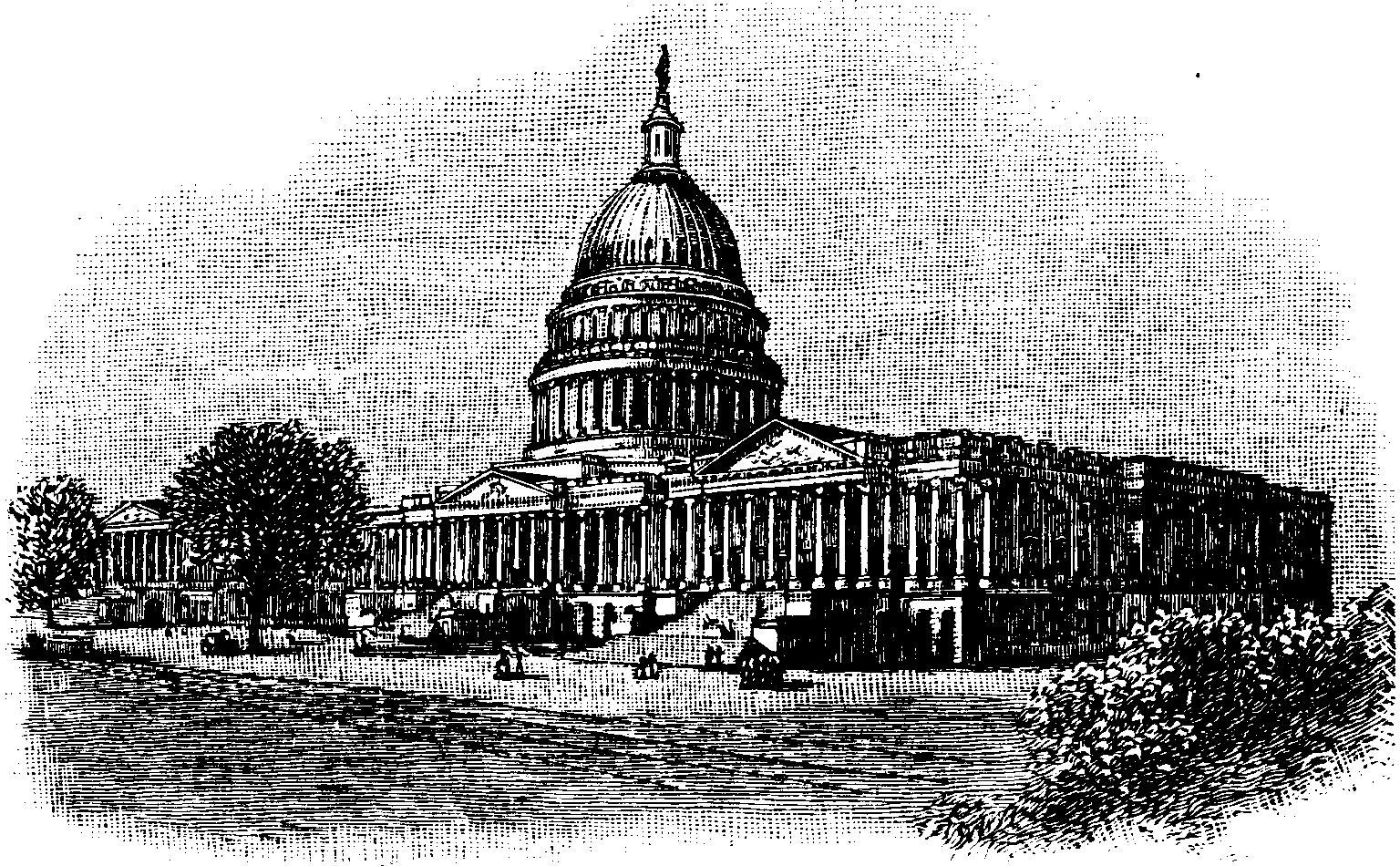
WALTER, Thomas Ustick, architect, born in Philadelphia, Pennsylvania, 4 September, 1804; died there, 30 October, 1887. His early education was liberal but not collegiate, and at the age of fifteen he entered the office of William Strickland, the architect of the mint and the custom-house, Philadelphia. After acquiring a knowledge of linear drawing and a general acquaintance with the professional practice of architects, he resumed his general studies, prosecuted them for seven years, and after two more years with Nr. Strickland he began practice as an architect in 1830. His first important work was the new county prison (1831), which is now generally known as Moyamensing jail, mid in 1833 he made the original designs for Girard college, and was sent to Europe by the building committee of that institution, that he might study there. On his return he took charge of the college building, which was completed in 1847, and which it is claimed is the finest specimen of classic architecture on this continent. Mr. Walter's next great work was the breakwater at Laguayra for the Venezuelan government; in 1851 his design for the extension of the capitol at Washington was adopted. Having been appointed government architect, he removed to Washington, and remained there till the completion of the work in 1865. (See illustration.) While in Washington he also designed the extensions of the patent-office, treasury, and post-office buildings, the dome on the old capitol, the congressional library, and the government hospital for the insane. Among the works of his private practice in Philadelphia were the designs for St. George's hall, the Preston retreat, and the Biddle and Cowperthwaite places on Delaware river. He assisted the architect; of the new Public buildings at Philadelphia in their erection, and was so engaged till his death. He was a member of the Franklin institute after 1829, held its professorship of architecture, and in 1860 delivered a course of lectures on that subject, in Columbia college, New York. He was a member of the American philosophical society after 1841, and was one of the original members of the American institute of architects, of which he was president at the time of his death. He received the degree of D. C. L. from the University of Lewisburg, Pennsylvania, in 1853, and that of LL.D. from Harvard in 1857.
Unauthorized Site:
This site and its contents are not affiliated, connected,
associated with or authorized by the individual, family,
friends, or trademarked entities utilizing any part or
the subject's entire name. Any official or affiliated
sites that are related to this subject will be hyper
linked below upon submission
and Evisum, Inc. review.
Please join us in our mission to incorporate The Congressional Evolution of the United States of America discovery-based curriculum into the classroom of every primary and secondary school in the United States of America by July 2, 2026, the nation’s 250th birthday. , the United States of America: We The
People. Click Here