LONGFELLOW, Stephen - A Stan Klos Biography
LONGFELLOW, Stephen, lawyer, born in Gorham, Maine,
23 June, 1775; died in Portland, Maine, 2 August, 1849. He was of the fourth
generation in lineal descent from William Longfellow, who had emigrated from
Yorkshire to Massachusetts and settled in Newbury about 1675, and in 1676
married a sister of Judge Samuel Sewall. Stephen was graduated at Harvard in
1798, admitted to the bar in 1801, and practiced successfully in Portland.
He was a delegate to the Hartford convention in 1814, and
was subsequently elected to the 18th congress as a Federalist, serving from 1
December, 1823, till 3 March, 1825. In 1834 he was president of the Maine
historical society, having previously been its recording secretary. In 1828 he
received the degree of LL. D. from Bowdoin. 'He compiled sixteen volumes of
Massachusetts and twelve volumes of Maine "Reports." He married the daughter of
General Peleg Wadsworth, an officer in the Revolution.
--Their son, Henry Wadsworth Longfellow, poet, born
in Portland, Maine, 27 February, 1807; died in Cambridge, Massachusetts, 24
March, 1882, was the second son in a family that included four sons and four
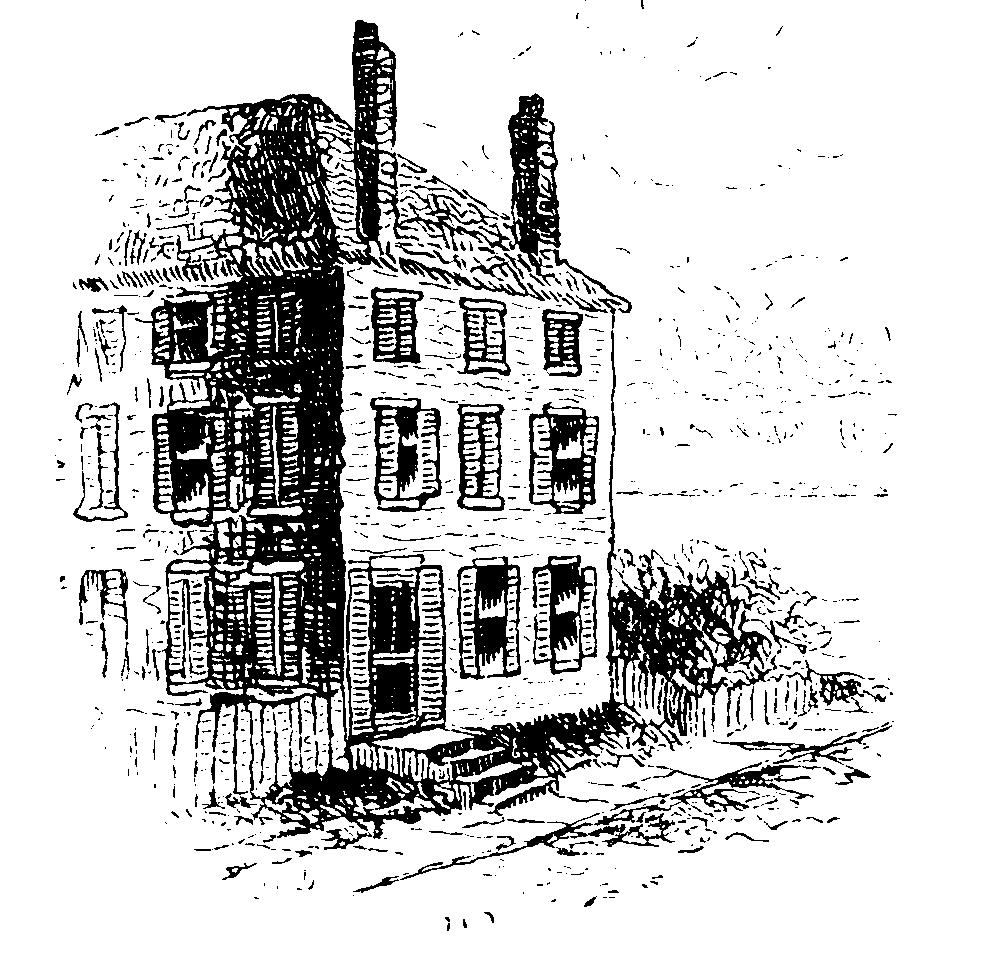
daughters. His birthplace, on Fore Street, is shown in the engraving on page 11.
He was named for a brother of his mother, who, a youth of nineteen, lately
commissioned lieutenant in the United States navy, and serving before Tripoli
under Commander Preble, had perished in the fire-ship "Intrepid," which was
blown up in the night of 4 September, 1804.
The boyhood of the poet was happy. A sweeter, simpler, more
essentially human society has seldom existed than that of New England in the
first quarter of this century, and the conditions of life in Portland were in
some respects especially pleasant and propitious.
The beautiful and wholesome situation of the town on the
sea-shore; the fine and picturesque harbor that afforded shelter to the vessels
by which a moderate commerce with remote regions was carried on, giving vivacity
to the port and widening the scope of the interests of the inhabitants; the
general diffusion of comfort and intelligence; the traditional purity and
simplicity of life; the absence of class distinctions; the democratic kindliness
of spirit; the pervading temper of hopefulness and content--all made Portland a
good place in which to be born and grow up.
Like the rest of New England it was provincial, it had
little part in the larger historic concerns of the world, it possessed no deep
wells of experience or of culture, and no memorials of a distant past by which
the imagination might be quickened and nurtured; it was a comparatively, new
place in a comparatively new country.
The sweetness of Longfellow's disposition showed itself in
his earliest years. He was a gentle, docile, cheerful, intelligent, attractive
child; "one of the best boys in school" was his teacher's report of him at six
years old. He was fond of books, and his father's library supplied him with the
best in English. He was sensitive to the charm of style in literature, and a
characteristic glimpse of his taste, and of the influences that were shaping
him, is afforded by what he said in later life in speaking of Irving :
"Every boy has his first book; I mean to say, one book
among all others which in early youth first fascinates his imagination, and at
once excites and satisfies the desires of his mind. To me this first book was
the 'Sketch-Book' of Washington Irving. I was a school-boy when it was published
[in 1819], and read each succeeding number with ever-increasing wonder and
delight, spell-bound by its pleasant humor, its melancholy tenderness, its
atmosphere of reverie The charm remains unbroken, and whenever I open the pages
of the 'Sketch-Book,' I open also that mysterious door which leads back into the
haunted chambers of youth."
Already, when he was thirteen years old, he had begun to
write verses, some of which found place in the poet's corner of the local
newspaper. In 1821 he passed the entrance examinations for Bowdoin, but it was
not until 1822 that Longfellow left home to reside at the college. Among his
classmates was Nathaniel Hawthorne, with whom he speedily formed an acquaintance
that was to ripen into a life-long friendship.
His letters to his mother and father during his years at
college throw a pleasant light upon his pursuits and his disposition; they
display the early maturity of his character; the traits that distinguished him
in later years are already clearly defined; the amiability, the
affectionateness, the candor, and the cheerful spirit of the youth are forecasts
of the distinguishing qualities of the man. His taste for literary pursuits, and
his strong moral sentiment and purpose, are already developed. A few sentences
from his letters will serve to exhibit him as he was at this time.
"I am in favor of letting each one think for himself,
and I am very much pleased with Gray's poems, Dr. Johnson to the contrary
notwithstanding."
"I have very resolutely concluded to enjoy myself
heartily wherever I am."
"Leisure is to me one of the sweetest things in the
world."
"I care but little about polities or anything of the
kind."
"I admire Horace very much indeed."
"I conceive that if religion is ever to benefit us, it
must be incorporated with our feelings and become in every degree identified
with our happiness."
"Whatever I study I ought to be engaged in with all my
soul, for I will be eminent in something."
"I am afraid you begin to think me rather chimerical in
many of my ideas, and that I am ambitious of becoming a rara avis in terris.
But you must acknowledge the usefulness of aiming high at something which it is
impossible to overshoot, perhaps to reach."
He was writing much, both verse and prose, and his pieces
had merit enough to secure publication, not only in the Portland paper, but in
more than one of the magazines, and especially in the "United States Literary
Gazette," published in Boston, in which no fewer than sixteen poems by him
appeared in the course of the year 1824-'5 Very few of these were thought by
their author worth reprinting in later years, and though they all show facile
versification and refined taste, none of them exhibits such original power as to
give assurance of his future fame. Several of them display the influence of
Bryant both in form and thought. Long afterward, in writing to Bryant,
Longfellow said: "Let me acknowledge how much I owe to you, not only of delight
but of culture. When I look back upon my earlier verses, I cannot but smile to
see how much in them is really yours." He owed much also to others, and in these
youthful compositions one may find traces of his favorite poets from Gray to
Byron.
As the time for leaving college drew near, it became
necessary for him to decide on a profession, He was averse to the ministry, to
medicine, and, in spite of his father's and grandfather's example, to the law.
In 1824 he writes to his father: "I am altogether in favor of the farmer's
life." But a few months later he says:
"The fact is, I most eagerly aspire after future eminence
in literature My whole soul burns most ardently for it, and every earthly
thought centres in it Surely there never was a better opportunity offered for
the exertion of literary talent in our own country than is now offered. Nature
has given me a very strong predilection for literary pursuits, and I am almost
confident in believing that, if I can ever rise in the world, it must be by the
exercise of my talent in the wide field of literature."
In reply to these ardent aspirations his father wisely
urged that, though a literary life might be very pleasant to one who had the
means of support, it did not offer secure promise of a livelihood, and that it
was necessary for his son to adopt a profession that should afford him
subsistence as well as reputation; but he gave his consent readily to his son's
passing a year in Cambridge, after leaving college, in literary studies previous
to entering on the study of a profession.
Before the time for this arrived a new prospect opened,
full of hope for the young scholar. He had distinguished himself in college by
his studious disposition, his excellent conduct, and his capacity as a writer,
and when their rank was assigned to the members of his class at graduation, he
stood upon the list as the fourth in general scholarship in a class of
thirty-eight.
Just at this time the trustees of the college determined to
establish a professorship of modern languages, and, not having the means to
obtain the services of any one that was already eminent in this department, they
determined to offer the post conditionally to the young graduate of their own
college, who had already given proof of character and abilities that would
enable him after proper preparation to fill the place satisfactorily. The
proposal was accordingly made to him that he should go to Europe for the purpose
of fitting himself for this chair, with the understanding that on his return he
should receive the appointment of professor. It was a remarkable testimony to
the impression that Longfellow had made and to the confidence he had inspired.
Nothing could have been more delightful to him than the prospect it opened. It
settled the question of his career in accordance with the desire of his heart,
and his father gladly approved.
After passing the autumn and winter of 1825-'6 in
preparatory studies at home in Portland, Longfellow sailed for Havre in May,
1826. The distance of Europe from America, measured by time, was far greater
then than now. Communication was comparatively infrequent and irregular; the
interval of news was often months long; the novelty of such an experience as
that on which Longfellow entered was great.
"Madam," said a friend to his mother, "you must have great
confidence in your son." "It is true, Henry," she wrote, "your parents have
great confidence in your uprightness and in that purity of mind which will
instantly take alarm on coming in contact with anything vicious or unworthy. We
have confidence; but you must be careful and watchful."
Sixty years ago Europe promised more to the young American
of poetic temperament than it does to-day, and kept its promise better.
Longfellow's character was already so mature, his culture so advanced, and his
temperament so happy, that no one could be better fitted than he to profit by a
visit to the Old World. A voyage to Europe is often a voyage of discovery of
himself to the young American; he learns that he possesses imagination and
sensibilities that have not been evoked in his own land and for which Europe
alone can provide the proper nurture. So it was with Longfellow.
He passed eight months in Paris and its neighborhood,
steadily at work in mastering the language, and in studying the literature and
life of France. In the spring of 1827 he went from France to Spain, and here he
spent a like period in similar occupations. It was a period of great enjoyment
for him. At Madrid he had the good fortune to make acquaintance with Irving, who
was then engaged in writing his "Life of Columbus," of Alexander Everett, the
United States minister, and of Lieutenant Alexander Slidell, United States navy
(afterward honorably known as Commander Slidell-Mackenzie), who in his "Year in
Spain" pleasantly mentions and gives a characteristic description of the young
traveler.
In December, 1827, Longfellow left Spain for Italy, where
he remained through a year that was crowded with delightful experience and was
well employed in gaining a rich store of knowledge. His studies were constant
and faithful, and his genius for language was such that when he went to Germany
at the end of 1828 he had a command of French, Spanish, and Italian such as is
seldom gained by a foreigner. He established himself at Gottingen in February,
1829, and was pursuing his studies there when he was called home by letters that
required his return.
He reached the United States in August, and in September,
having received the appointment of professor of modern languages at Bowdoin
College, with a salary of $800, he took up his residence at Brunswick. He was
now twenty-two years old, and probably, with the exception of Mr. George Ticknor,
was the most accomplished scholar in this country of the languages and
literatures of modern Europe.
He devoted himself zealously to teaching, to editing for
his classes several excellent text-books, and to writing a series of lectures on
the literatures of France, Spain, and Italy. The influence of such a nature and
such tastes and learning as his was of the highest value in a country college
remote from the deeper sources of culture. "His intercourse with the students,"
wrote one of his pupils, "was perfectly simple, frank, and manly. They always
left him not only with admiration, but guided, helped, and inspired."
In addition to his duties as professor he performed those
of librarian of the college, and in April. 1831, he published in the "North
American Review" the first of a series of articles, which were continued at
irregular intervals for several years, upon topics that were connected with his
studies. His prose style was already formed, and was stamped with the purity and
charm that were the expression of his whole nature, intellectual and moral.
Poetry he had for the time given up. Of those little poetic attempts dating from
his college years he wrote, that he had long ceased to attach any value to them.
" I am all prudence now, since I can form a more accurate judgment of the merit
of poetry. If I ever publish a volume, it will be many years first."
In September, 1831, he married Miss Mary Potter, of
Portland. It was a happy marriage. About the same time he began to publish in
the " New England Magazine" the sketches of travel that afterward were
collected, and, with the addition of some others, published under the title of "Outre
Mer; a Pilgrimage beyond the Sea" (New York, 1835). This was his earliest
independent contribution to American literature, and in its pleasant mingling of
the record of personal experience, with essays on literature, translations, and
romantic stories, and in the ease and grace of its style, it is a worthy prelude
and introduction to his later more important works.
Edited Appletons Encyclopedia by John Looby, Copyright © 2001 VirtualologyTM
LONGFELLOW, Stephen, lawyer, born in Gorham, Maine, 23 June, 1775; died in Portland, Maine, 2 August, 1849. He was of the fourth generation in lineal descent from William Longfellow, who had emigrated from Yorkshire to Massachusetts and settled in Newbury about 1675, and in 1676 married a sister of Judge Samuel Sewall. Stephen was graduated at Harvard in 1798, admitted to the bar in 1801, and practised successfully in Portland. He" was a delegate to the Hartford convention in 1814, and was subsequently elected to the 18th congress as a Federalist, serving from 1 December, 1823, till 3 March, 1825. In 1834 he was president of the Maine historical society, having previously been its recording secretary. In 1828 he received the degree of LL. D. from Bowdoin. 'He compiled sixteen volumes of Massachusetts and twelve volumes of Maine " Reports." He married the daughter of General Peleg Wadsworth, an officer in the Revolution.--Their son, Henry Wadsworth, poet, born in Portland, Maine. 27 February, 1807; died in Cambridge, Massachusetts, 24 March, 1882, was the second son in a family that included four sons and four daughters. His birthplace, on Fore street, is shown in the engraving on page 11. He was named for a brother of his mother, who, a youth of nineteen, lately commissioned lieutenant in the United States navy, and serving before Tripoli under Commander Preble, had perished in the fire-ship "Intrepid," which was blown up in the night of 4 September, 1804. The boyhood of the poet was happy. A sweeter, simpler, more essentially human society has seldom existed than that of New England in the first quarter of this century, and the conditions of life in Portland were in some respects especially pleasant and propitious. The beautiful and wholesome situation of the town on the sea-shore; the fine and picturesque harbor that afforded shelter to the vessels by which a moderate commerce with remote regions was carried on, giving vivacity to the port and widening the scope of the interests of the inhabitants; the general diffusion of comfort and intelligence; the traditional purity and simplicity of life; the absence of class distinctions; the democratic kindliness of spirit ; the pervading temper of hopefulness and content--all made Portland a good place in which to be born and grow up. Like the rest of New England it was provincial, it had little part in the larger historic concerns of the world, it possessed no deep wells of experience or of culture, and no memorials of a distant past by which the imagination might be quickened and nurtured; it was a comparatively, new place in a comparatively new country. The sweetness of Longfellow's disposition showed itself in his earliest years. He was a gentle, docile, cheerful, intelligent, attractive child ; "one of the best boys in school" was his teacher's report of him at six years old. He was fond of books, and his father's library supplied him with the best in English. He was sensitive to the charm of style in literature, and a characteristic glimpse of his taste, and of the influences that were shaping him, is afforded by what he said in later life in speaking of Irving : "Every boy has his first book ; i mean to say, one book among all others which in early youth first fascinates his imagination, and at once excites and satisfies the desires of his mind To me this first book was the 'Sketch-Book' of Washington Irving. I was a school-boy when it was published [in 1819], and read each succeeding number with ever-increasing wonder and delight, spell-bound by its pleasant humor, its melancholy tenderness, its atmosphere of reverie The charm remains unbroken, and whenever I open the pages of the 'Sketch-Book, ' I open also that mysterious door which leads back into the haunted chambers of youth." Already, when he was thirteen years old, he had begun to write verses, some of which found place in the poet's corner of the local newspaper. In 1821 he passed the entrance examinations for Bowdoin, but it was not until 1822 that Longfellow left home to reside at the college. Among his classmates was Nathaniel Hawthorne, with whom he speedily formed an acquaintance that was to ripen into a life-long friendship. His letters to his mother and father during his years at college throw a pleasant light upon his pursuits and his disposition ; they display the early maturity of his character; the traits that distinguished him in later years are already clearly defined; the amiability, the affectionateness, the candor, and the cheerful spirit of the youth are forecasts of the distinguishing qualities of the man. His taste for literary pursuits, and his strong moral sentiment and purpose, are already developed. A few sentences from his letters will serve to exhibit him as he was at this time. "I am in favor of letting each one think for himself, and I am very much pleased with Gray's poems, Dr. Johnson to the contrary notwithstanding." "I have very resolutely concluded to enjoy myself heartily wherever I am." "Leisure is to me one of the sweetest things in the world." "I care but little about polities or anything of the kind." " I admire Horace very much indeed." "I conceive that if religion is ever to benefit us, it must be incorporated with our feelings and become in every degree identified with our happiness." "Whatever I study I ought to be engaged in with all my soul, for I will be eminent in something." " I am afraid you begin to think me rather chimerical in many of my ideas, and that I am ambitious of becoming a rara avis in terris. But you must acknowledge the usefulness of aiming high at something which it is impossible to overshoot, perhaps to reach." He was writing much, both verse and prose, and his pieces had merit enough to secure publication, not only in the Portland paper, but in more than one of the magazines, and especially in the "United States Literary Gazette," published in Boston, in which no fewer than sixteen poems by him appeared in the course of the year 1824-'5 Very few of these were thought by their author worth reprinting in later years, and though they all show facile versification and refined taste, none of them exhibit such original power as to give assurance of his future fame. Several of them display the influence of Bryant both in form and thought. Long afterward, in writing to Bryant, Longfellow said: "Let me acknowledge how much I owe to you, not only of delight but of culture. When I look back upon my earlier verses, I cannot but smile to see how much in them is really yours." He owed much also to others, and in these youthful compositions one may find traces of his favorite poets from Gray to Byron.
As the time for leaving college drew near, it became necessary for him to decide on a profession, He was averse to the ministry, to medicine, and, in spite of his father's and grandfather's example, to the law. In 1824 he writes to his father: "I am altogether in favor of the farmer's life." But a few months later he says: "The fact is, I most eagerly aspire after future eminence in literature My whole soul burns most ardently for it, and every earthly thought centres in it Surely there never was a better opportunity offered for the exertion of literary talent in our own country than is now offered Nature has given me a very strong predilection for literary pursuits, and I am almost confident in believing that, if I can ever rise in the world, it must be by the exercise of my talent in the wide field of literature." In reply to these ardent aspirations his father wisely urged that, though a literary life might be very pleasant to one who had the means of support, it did not offer secure promise of a livelihood, and that it was necessary for his son to adopt a profession that should afford him subsistence as well as reputation; but he gave his consent readily to his son's passing a year in Cambridge, after leaving college, in literary studies previous to entering on the study of a profession.
Before the time for this arrived a new prospect opened, full of hope for the young scholar. He had distinguished himself in college by his studious disposition, his excellent conduct, and his capacity as a writer, and when their rank was assigned to the members of his class at graduation, he stood upon the list as the fourth in general scholarship in a class of thirty-eight. Just at this time the trustees of the college determined to establish a professorship of modern languages, and, not having the means to obtain the services of any one that was already eminent in this department, they determined to offer the post conditionally to the young graduate of their own college, who had already given proof of character and abilities that would enable him after proper preparation to fill the place satisfactorily. The proposal was accordingly made to him that he should go to Europe for the purpose of fitting himself for this chair, with the understanding that on his return he should receive the appointment of professor. It was a remarkable testimony to the impression that Longfellow had made and to the confidence he had inspired. Nothing could have been more delightful to him than the prospect it opened. It settled the question of his career in accordance with the desire of his heart, and his father gladly approved.
After passing the autumn and winter of 1825-'6 in preparatory studies at home in Portland, Longfellow sailed for Havre in May, 1826. The distance of Europe from America, measured by time, was far greater then than now. Communication was comparatively infrequent and irregular ; the interval of news was often months long; the novelty of such an experience as that on which Longfellow entered was great. "Madam," said a friend to his mother, "you must have great confidence in your son." "It is true, Henry," she wrote, "your parents have great confidence in your uprightness and in that purity of mind which will instantly take alarm on coming in contact with anything vicious or unworthy. We have confidence ; but you must be careful and watchful." Sixty years ago Europe promised more to the young American of poetic temperament than it does to-day, and kept its promise better. Longfellow's character was already so mature, his culture so advanced, and his temperament so happy, that no one could be better fitted than he to profit by a visit to the Old World. A voyage to Europe is often a voyage of discovery of himself to the young American ; he learns that he possesses imagination and sensibilities that have not been evoked in his own land and for which Europe alone can provide the proper nurture. So it was with Longfellow. He passed eight months in Paris and its neighborhood, steadily at work in mastering the language, and in studying the literature and life of France. In the spring of 1827 he went from France to Spain, and here he spent a like period in similar occupations. It was a period of great enjoyment for him. At Madrid he had the good fortune to make acquaintance with Irving, who was then engaged in writing his "Life of Columbus," of Alexander Everett, the United States minister, and of Lieutenant Alexander Slidell, United States navy (afterward honorably known as Commander Slidell-Mackenzie), who in his "Year in Spain" pleasantly mentions and gives a characteristic description of the young traveller. In December, 1827, Longfellow left Spain for Italy, where he remained through a year that was crowded with delightful experience and was well employed in gaining a rich store of knowledge. His studies were constant and faithful, and his genius for language was such that when he went to Germany at the end of 1828 he had a command of French, Spanish, and Italian such as is seldom gained by a foreigner. He established himself at Gottingen in February, 1829, and was pursuing his studies there when he was called home by letters that required his return. He reached the United States in August, and in September, having received the appointment of professor of modern languages at Bowdoin college, with a salary of $800, he took up his residence at Brunswick. He was now twenty-two years old, and probably, with the exception of Mr. George Ticknor, was the most accomplished scholar in this country of the languages and literatures of modern Europe. He devoted himself zealously to teaching, to editing for his classes several excellent text-books, and to writing a series of lectures on the literatures of France, Spain, and Italy. The influence of such a nature and such tastes and learning as his was of the highest value in a country college remote from the deeper sources of culture. "His intercourse with the students," wrote one of his pupils, "was perfectly simple, frank, and manly. They always left him not only with admiration, but guided, helped, and inspired." In addition to his duties as professor he performed those of librarian of the college, and in April. 1831, he published in the "North American Review" the first of a series of articles, which were continued at irregular intervals for several years, upon topics that were connected with his studies. His prose style was already formed, and was stamped with the purity and charm that were the expression of his whole nature, intellectual and moral. Poetry he had for the time given up. Of those little poetic attempts dating from his college years he wrote, that he had long ceased to attach any value to them. " I am all prudence now, since I can form a more accurate judgment of the merit of poetry. If I ever publish a volume, it will be many years first."
In September, 1831, he married Miss Mary Potter, of Portland. It was a happy marriage. About the same time he began to publish in the " New England Magazine" the sketches of travel that afterward were collected, and, with the addition of some others, published under the title of "Outre Mer ; a Pilgrimage beyond the Sea" (New York, 1835). This was his earliest independent contribution to American literature, and in its pleasant mingling of the record of personal experience, with essays on literature, translations, and romantic stories, and in the ease and grace of its style, it is a worthy prelude and introduction to his later more important work. The narrowness of the opportunities that were afforded at Bowdoin for literary culture and conversation prevented the situation there from being altogether congenial to him, and it was with satisfaction that he received in December, 1834, an invitation to succeed Mr. George Ticknor in the Smith professorship of modern languages at Harvard, with the suggestion that, before entering on its duties, he should spend a year or eighteen months in Europe for study in Germany. He accordingly resigned the professorship at Bowdoin, which he had held for five years and a half, and in April, 1835, he set sail with his wife for England. In June he went to Denmark, and, after passing the summer at Copenhagen and Stockholm studying the Danish, Swedish, and Finnish languages, he went in October to Holland on his way to Germany. At Amsterdam and Rotterdam he was de-rained by the serious illness of Mrs. Longfellow, and employed his enforced leisure in acquiring the Dutch language. Near the end of November his wife died at Rotterdam. The blow fell heavily upon him; but his strong religious faith afforded him support, and he was not overmastered by vain grief. He soon proceeded to Heidelberg, and sought in serious and constant study a relief from suffering, bereavement, and dejection. For a time he was cheered by the companionship of Bryant, whom he met here for the first time. In the spring he made some excursions in the beautiful regions in the neighborhood of the Rhine, and he spent the summer in Switzerland and the Tyrol. In September he was at Paris, and in October he returned home.
In December, 1836, he established himself at Cambridge, and entered upon his duties as professor. For the remainder of his life Cambridge was to be his home. Lowell, in his delightful essay, "Cambridge Thirty Years Ago," has preserved the image of the village much as it was at this period. The little town was not yet suburbanized; it was dominated by the college, whose professors, many of them men of note, formed a cultivated and agreeable society. Limited as were its intellectual resources as compared with those that it has since acquired, its was the chief centre in New England of literary activity and cultivated intelligence. Longfellow soon found friends, who speedily became closely attached to him, both in Boston and Cambridge, alike of the elder and younger generation of scholars, chief among whom were George Ticknor, William H. Prescott, Andrews Norton, John G. Palfrey, Cornelius C. Felton, Charles Sumner, George S. Hillard, and Henry R. Cleveland. His delightful qualities of heart and mind, his social charm, his wide and elegant culture, his refinement, the sweetness of his temper, the openness of his nature, and his quick sympathies, made him a rare acquisition in any society, and secured for him warm regard and affection. He employed himself busily in instruction and the writing of lectures, and in 1837 he began once more to give himself to poetry, and wrote the poems that were to be the foundation of his future fame. In the autumn of this year he took up his residence at Craigie House, a fine old colonial mansion, consecrated by memories of Washington's stay in it, which was thenceforward to be his abode for life. Here, in 1837, he wrote "The Reaper and the Flowers," and in June, 1838, "The Psalm of Life," which, on its publication in the "Knickerbocker Magazine" for October, instantly became popular, and made its author's name well known. It was the sound of a new voice, a most musical and moving one, in American poetry. In February, 1838, he was lecturing on Dante; in the summer of that year his course was on "The Lives of Literary Men." He was writing also for the " North American Review," and during the year he began his "Hyperion." It was a busy and fruitful time. "Hyperion" was published in New York in 1839. It was a romance based upon personal experience. The scene was laid among the sites he had lately visited in Europe; the characters were drawn in part from life. He put into his story the pain, the passion, and the ideals of his heart. It was a book to touch the soul of fervent youth. It had much beauty of fancy, and it showed how deeply the imagination of the young American had been stirred by the poetic associations of Europe, and enriched by the abundant sources of foreign culture. It was hardly out of press before it was followed by the publication, in the late autumn, of his first volume of poems, "Voices of the Night." This contained, in addition to his recent poems, a selection of seven of his early poems--all that he wished to preserve --and numerous translations from the Spanish, Italian, and German. The little volume of 144 pages contained poems that were stamped with the impress of an original genius whose voice was of a tone unheard before. " The Psalm of Life," " The Reaper and the Flowers," " The Footsteps of Angels," " The Beleaguered City," speedily became popular, and have remained familiar to English readers from that day to this. "Nothing equal to some of them was ever written in this world--this western world, I mean," wrote his friend Hawthorne. Before a year was out the volume had come to a third edition. From this time Longfellow's fame grew rapidly. Success and reputation were to him but stimulants to new exertions. Essentially modest and simple, praise or flattery could do him no harm. His genial and sound nature turned all experience to good.
During the next two or three years, while his laborious duties as instructor were faithfully and successfully discharged, he still found time for study, and his vein of poetry was in full flow. In 1841 his second volume of poems was published; it was entitled " Ballads and other Poems," and contained, among other well-known pieces, "The Wreck of the Hesperus," " The Village Blacksmith," and " Excelsior." It confirmed the impression that had been made bythe "Voices of the Night," and henceforth Longfellow stood confessedly as the most widely read and the best beloved of American poets. In the spring of 1842, his health having been for some time in an unsatisfactory state, he received leave of absence for six months from the college, and went abroad. After a short stay in Paris he made a journey, abounding in interest and poetic suggestions, through Belgium, visiting Bruges, Ghent, Antwerp, and Brussels, and proceeded to Marienberg-on-the Rhine, where he spent a quiet but pleasant summer at a water-cure establishment. Here he made acquaintance with the German poet Freiligrath, and the cordial friendship then formed with him was maintained by letters until Freiligrath's death, more than thirty years afterward. In October he passed some delightful days in London, as the guest of Charles Dickens, with whom he had come into very cordial relations in America early in the same year, and in November he was again at home engaged in his familiar pursuits. On the return voyage he wrote "Poems on Slavery," which were published in a thin pamphlet before the end of the year. They were the expression not so much of poetic emotion as of moral feeling. They attracted much attention, as the testimony of a poet, by nature disinclined to censure, against the great national crime of which the worst evil was its corrupting influence upon the public conscience. It was to that conscience that these poems appealed, and they were received on the one hand with warm approval, on the other with still warmer condemnation. In June, 1843, he married Frances Appleton, daughter of the Hon. Nathan Appleton, of Boston. He had been attached to her since their first meeting in Switzerland in 1836, and something of his feeling toward her had been revealed in his delineation of the character of Mary Ashburton in " Hyperion." She was a woman whose high and rare qualities of character found harmonious expression in beauty of person and nobility of presence. Seldom has there been a happier marriage. From this time forward for many years Longfellow's life flowed on as peacefully and with as much joy as ever falls to man. His fortunes were prosperous. His books were beginning to bring him in a considerable income; his wife's dowry was such as to secure to him pecuniary ease; Craigie House, with the pleasant fields in front of it reaching to the river Charles, was now his own, and his means enabled him to gratify his taste for a refined hospitality no less than to satisfy the generous impulses of his liberal disposition, and to meet the multitude of appeals for help that came to him from the poor and suffering, who, though they might be remote and unknown to him, felt confident of his sympathy. The general character of these years and of their influence on him is reflected in his work. His genius found in them the moment of its fullest expansion and happiest inspiration. In the year of his marriage "The Spanish Student" was published in a volume. It had been mainly written three years before, and was first printed in "Graham's Magazine" in 1842. In 1846 "The Belfry of Bruges and other Poems" appeared; among the "other Poems" were " The Old Clock on the Stairs" and "The Arsenal at Springfield." This was followed by "Evangeline" (1847), of which Hawthorne wrote to him: "I have read it with more pleasure than it would be decorous to express," and which thousands upon thousands have read, and will read, with hearts touched and improved by its serene and pathetic beauty. Then appeared "Kavanagh," a tale in prose (1849) ; "The Seaside and the Fireside," containing " The Building of the Ship," " Resignation," " The Fire of Driftwood," and twenty other poems (1850); and "The Golden Legend" (1851).
During all these years he had continued to discharge the active duties of his professorship, but they had gradually become irksome to him, and in 1854, after nearly eighteen years of service at Harvard, he resigned the place. "I want to try, he wrote to Freiligrath, "the effect of change on my mind, and of freedom from routine. Household occupations, children, relatives, friends, strangers, and college lectures so completely fill up my days that I have no time for poetry; and, consequently, the last two years have been very unproductive with me. I am not, however, very sure or sanguine about the result." But he was hardly free from the daily duties of instruction before he was at work upon "Hiawatha," and in the course of the year he wrote many shorter pieces, among his best, such as "The Rope-Walk," " My Lost Youth," and "The Two Angels." "Hiawatha" was published in 1855, and in 1858 appeared "The' Courtship of Miles Standish," with about twenty minor poems.
But the days of joyful inspiration and success were drawing to their close. In July, 1861, an inexpressible calamity, by which all his later life was shadowed, fell upon him, in the sudden and most distressing death of his wife by fire. His recovery from its immediate, shattering effect was assisted by the soundness of his nature, the strength of his principles, and the confidence of his religious faith, but it was long before he could resume his usual occupations, or find interest in them. After several months, for the sake of a regular pursuit that might have power more or less to engage his thought, he took up the translation of the "Divine Comedy." He found the daily task wholesome, and gradually he became interested in it. For the next three or four years the translation, the revision of it for the press, and the compilation of the notes that were to accompany it, occupied much of his time. The work was published in 1867, and took rank at once as the best translation in English of Dante's poem. The accomplishment of this task had not only been a wholesome restorative of intellectual calm, but had been the means of bringing about in a natural and simple way the renewal of social pleasures and domestic hospitalities. In the revision of the work, Longfellow had called to his aid his friends, James Russell Lowell and the present writer ; and the " Dante Club" thus formed met regularly at Craigie House one evening every week for two or three winters. Other friends often joined the circle, and the evenings ended with a cheerful supper. Thus, by degrees, with the passing of time, the current of life began once more to run on in a tranquil course, and though without a ray of the old sunlight, equally without a shadow of gloom. At the end of 1863 he published "Tales of a Wayside Inn," a volume in which there was no lowering of tone, no utterance of sorrow, but full vigor and life in such poems as "Paul Revere's Ride," "The Birds of Killingworth," " The Children's Hour," and others. The printing of the translation of the "Divine Comedy" was begun about the same time, and the text of the "Inferno" was completed in season to send to Florence the volume, not yet published, as an offering in honor of Dante, on occasion of the celebration in that city of the sixth centenary of the poet's birth in May, 1865. The whole translation, with its comment, was finally published in 1867. In the same year appeared a little volume of original poems, entitled " Flower de Luce," and in succeeding years, at irregular intervals, he wrote and published "The New England Tragedies" (1868) ; "The Divine Tragedy" (1871) ; "Three Books of Song" (1872); " Aftermath" (1874) ; "The Masque of Pandora" (1875) ; "Keramos" (1878); and " Ultima Thule" (1880). A little volume containing his last poems was published in 1882, after the poet's death, with the title of " In the Harbor."
These years had been marked by few striking events in his external life. They had been spent for the most part at Cambridge, with a summer residence each year at Nahant. His interests were chiefly domestic and social ; his pursuits were the labors and the pleasures of a poet and a man of letters. His hospitality was large and gracious, cordial to old friends, and genial to new acquaintances. His constantly growing fame burdened him with a crowd of visitors and a multitude of letters from "entire strangers." They broke in upon his time, and made a vast tax upon his good nature. He was often wearied by the incessant demands, but he regarded them as largely a claim of humanity upon his charity, and his charity never failed. He had a kind word for all, and with ready sacrifice of himself he dispensed pleasure to thousands. In 1868 and 1869, accompanied by his daughters, he visited Europe for the last time, and enjoyed a delightful stay in England, in Paris, and especially in Italy. Fame and the affection that his poems had awakened for him, though personally unknown, in the hearts of many in the Old World not less than in the New, made his visit to Europe a series of honors and of pleasures. But he returned home glad to enjoy once more its comparative tranquillity, and to renew the accustomed course of the day. His last years were the fitting close of such a life. In 1875 he read at Brunswick, on the fiftieth anniversary of his graduation, the beautiful poem " Morituri Salutamus." It ended with the characteristic verse-- " For age is opportunity no less Than youth itself, though in another dress, And as the evening twilight fades away, The sky is filled with stars, invisible by day."
On his seventy-fourth birthday, 27 February, 1881, he wrote in his diary: "I am surrounded by roses and lilies. Flowers everywhere--
And that which should accompany old age, As honor, love, obedience, troops of friends.' "
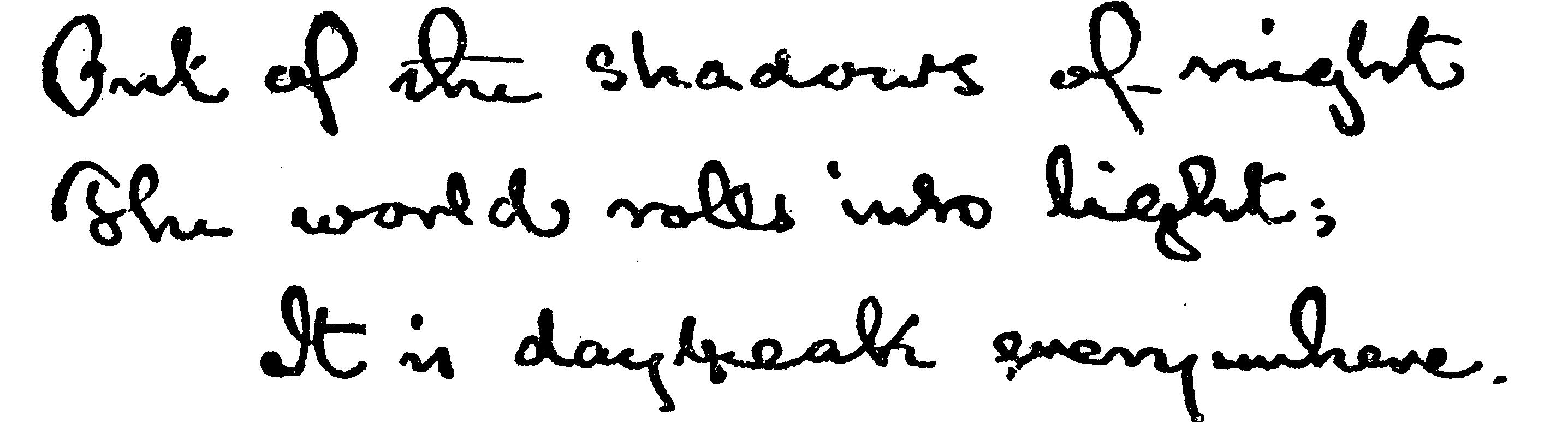
But he had had already warnings of declining health, and in the course of this year he suffered greatly from vertigo, followed by nervous pain and depression. The serenity of his spirit was unaffected. On the 18th he suffered a chill, and became seriously ill. On the 24th he sank quietly in death. The lines given in fac-simile were the last written by the poet, 15 March, 1882, and are from the closing stanza of the "Bells of San Blas."
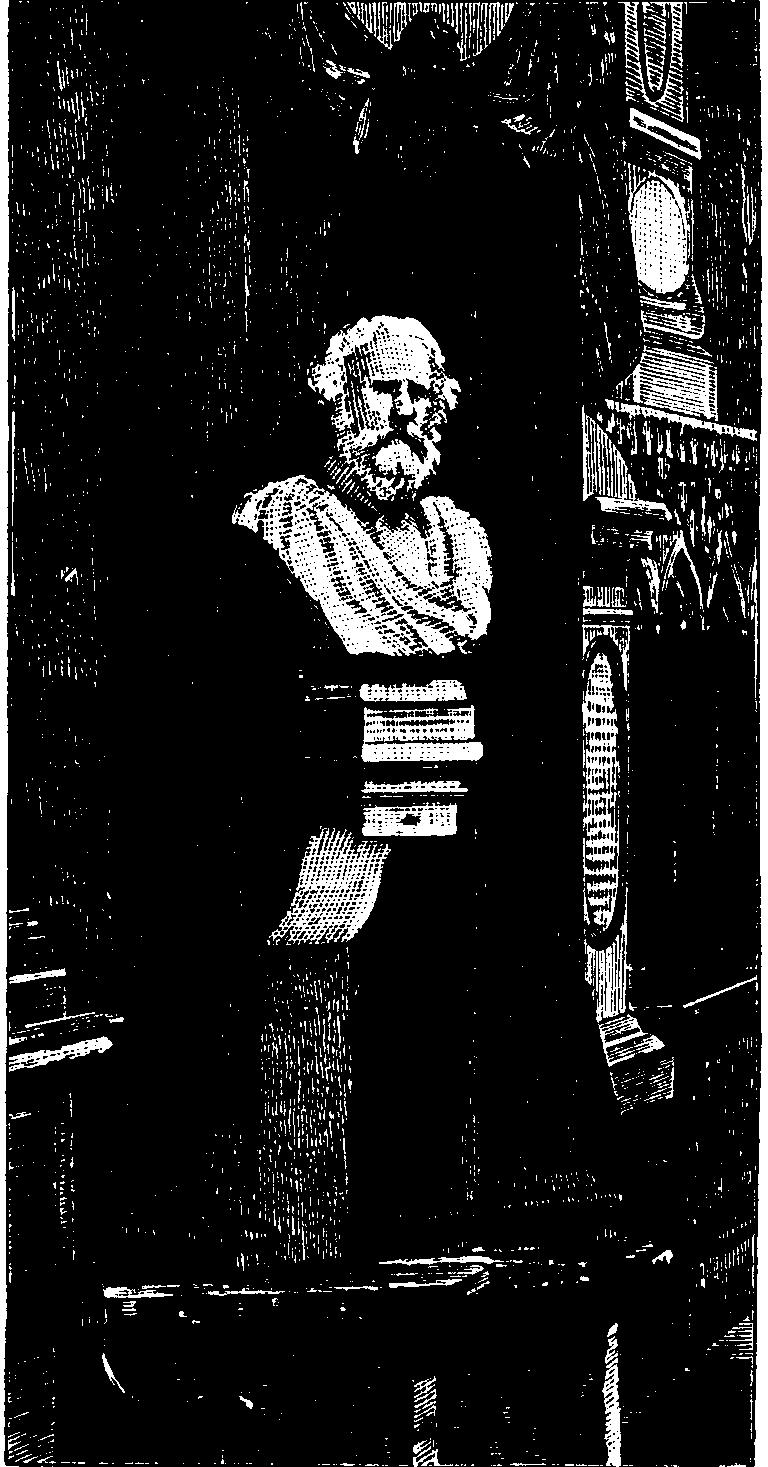
No poet was ever more beloved than he ; none was ever more worthy of love. The expressions of the feeling toward him after death were deep, affecting, and innumerable. One of the most striking was the placing of his bust in the Poet's Corner in Westminster Abbey in March, 1884. It was the passing through various hands, it was purchased on 1 January, 1793, by Andrew Craigie, who built the west wing. Mr. Craigie had made a fortune as apothecary-general to the Continental army, and he entertained in the house with lavish hospitality. After his death his widow, whose income had become reduced, let rooms to various occupants, among whom were Jared Sparks and Edward Everett. Finally the house passed into Longfellow's hands, as is related above. It is now (1887) occupied by his eldest daughter. His study remains unaltered as he left it. Mr. Longfellow had two sons and three daughters, by his second wife. His eldest son, CHARLES, entered the National service in 1861, and was badly wounded at Mine Run. His daughters, as children, were the subjects of a celebrated portrait group by Thomas Buchanan Read.--Henry Wadsworth's brother, Samuel, clergyman, born in Portland, Maine, 18 June, 1819, was graduated at Harvard in 1839 and at the divinity-school there in 1846. He first accepted a call to a church at Fall River in 1848, but in 1853 became the pastor of a Unitarian congregation in Brooklyn, New York In 1860 he resigned his charge and went abroad. On his return he resided at Cambridge, Massachusetts, continuing to preach, but having no pastoral charge till in first instance of such an honor being paid to an American poet. His bust stands near the tomb of Chaucer, between the memorials to Cowley and Dryden. (See illustration on page 14.) On this occasion Mr. Lowell, then United States minister in England, said: "Never was a private character more answerable to public performance than that of Longfellow. Never have I known a more beautiful character." A bronze statue of Longfellow, by Franklin Simmons, will be erected in Portland in the spring of 1888. His "Life" has been written by his brother Samuel, in three volumes (Boston, 1886-'7). [['his work, mainly compiled from the poet's diaries and letters, is a full and satisfactory picture of the man. In this life there is a bibliography of his works. The meadow, across the street, in front of the poet's home, stretching down to the river Charles, so often commemorated in his verse, was given by his children shortly after his death to the Longfellow memorial association, on condition that it should be kept open forever, and properly laid out for public enjoyment. The view over the river, of the hills of Brighton and Brookline, as seen from the windows of Longfellow's study, will thus be kept open, and associated with his memory.
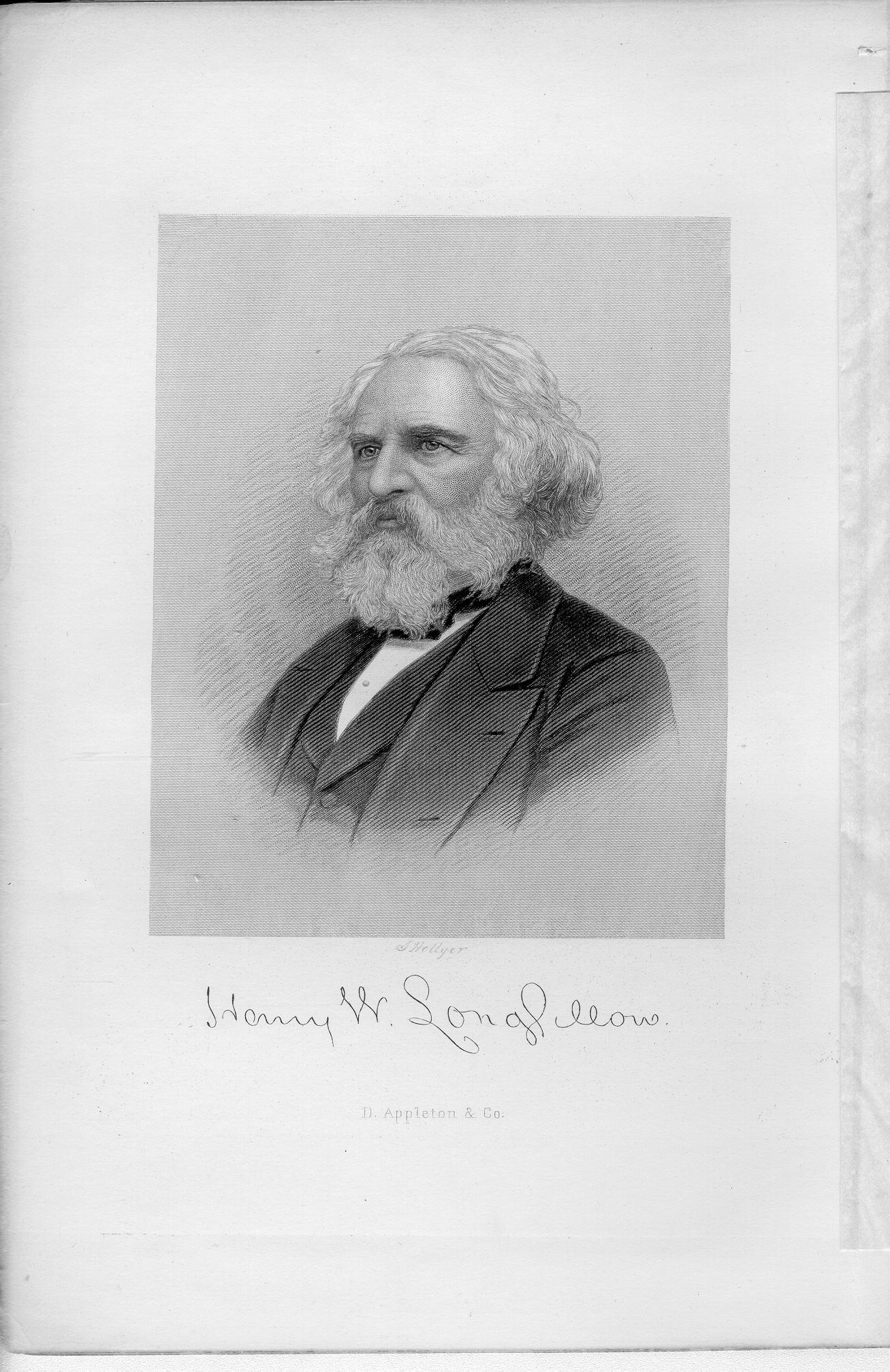
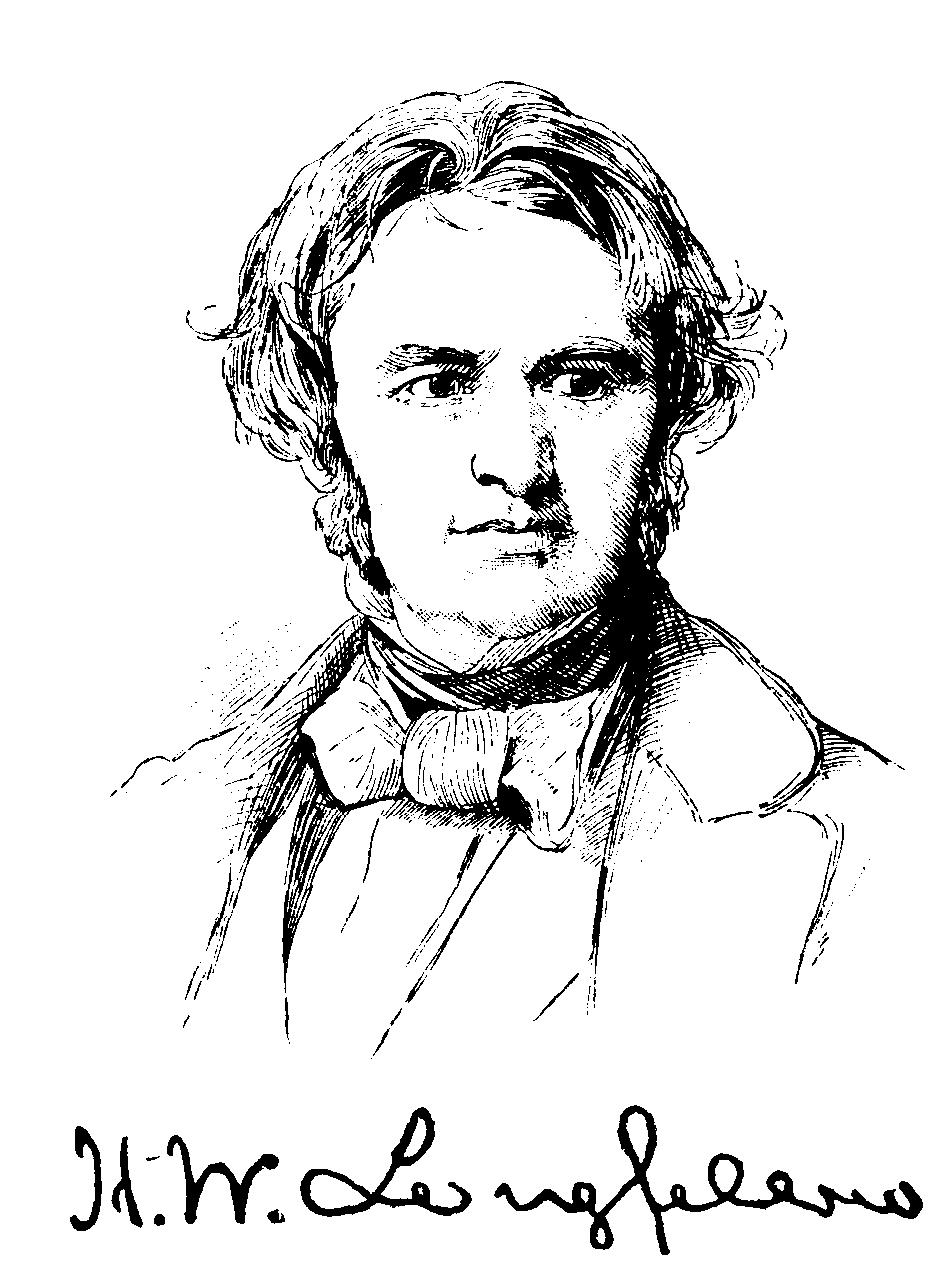
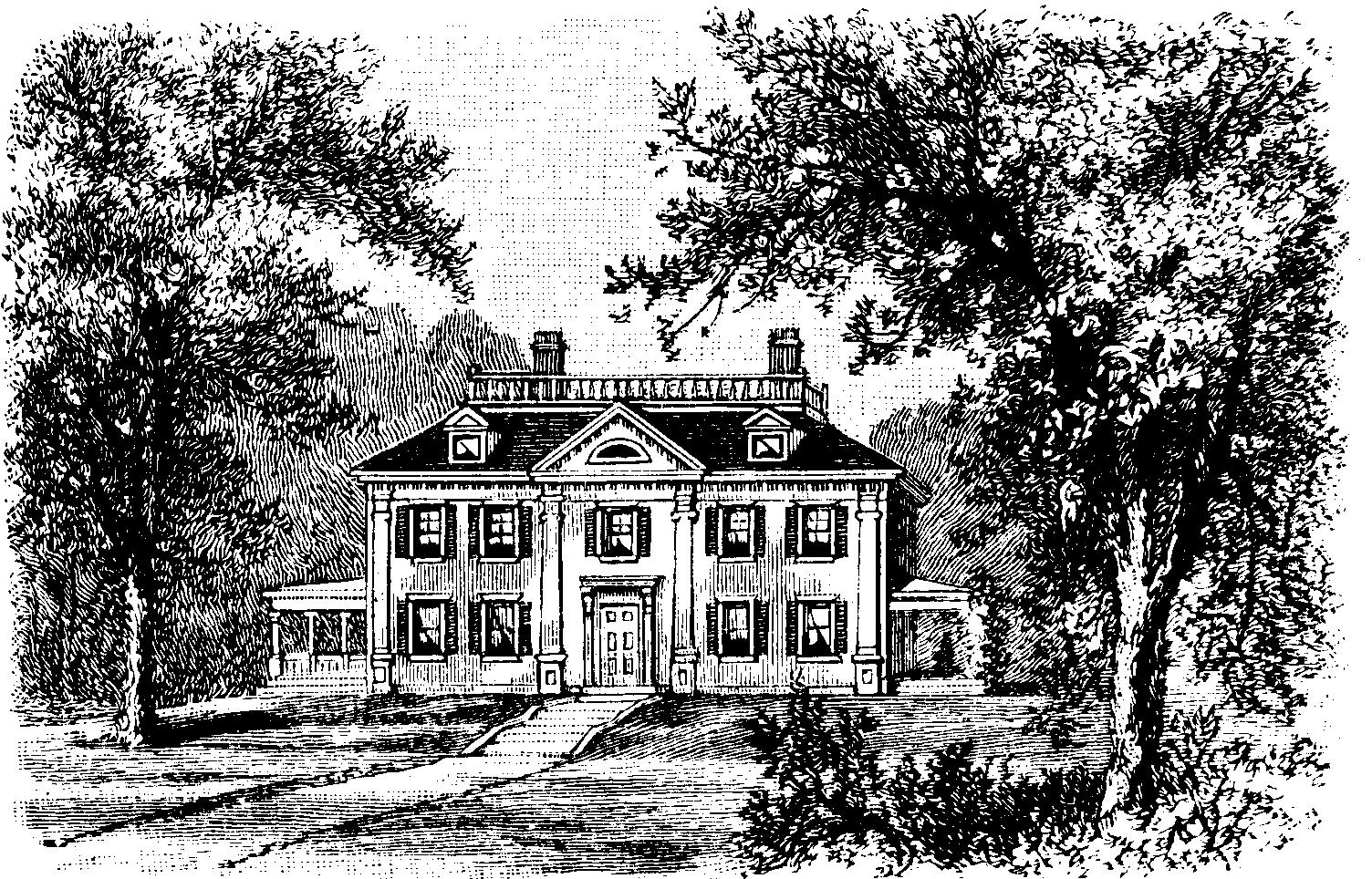
The vignette on page 10 is from a portrait made in 1856 by Samuel Laurence; the frontispiece on steel is a copy of one of the latest photographs of the poet. The illustration on page 12 represents Longfellow's home, Craigie House. It was built by Colonel John Vassall in 1759, and on his flight to England, at the beginning of the Revolution, was confiscated. It served as Washington's headquarters till the evacuation of Boston, and then, after 1878 he became the minister of a church in Germantown, Pennsylvania In 1882 he again returned to Cambridge. In addition to writing several essays that appeared in the "Radical" (1866-'71), and many hymns that have a place in other collections than his own, he compiled, in association with Reverend Samuel Johnson, "A Book of Hymns" (Boston, 1846; revised ed., entitled "Hymns of the Spirit," 1864). He published "A Book of Hymns and Tunes," for congregational use (1859), and a small volume for the vesper service that he had instituted. He is also the editor, in connection with Thomas W. Higginson, of "Thalatta, a Book for the Seaside," a collection of poetry, partly original (1853). His latest publications are the "Life of Henry Wadsworth Longfellow" (2 vols., 1886), and "Final Memorials of Henry W. Longfellow" (1887).--Henry Wadsworth's son, Ernest Wadsworth, artist, born in Cambridge, Massachusetts, in 1845, was a pupil of Couture at Paris in 1865, and painted in Italy in 1868. His studio was at first in Cambridge, but is now (1887) in New York. He paints with a firm hand and brilliant but harmonious scheme of color, and is favorably known for such effective landscapes and compositions as "Old Mill at Manchester, Massachusetts" ; "Italian Pines" (1880) ; " Love Me, Love my Dog" ; " Misty Morning" ; and "John and Priscilla," one of his most popular works.