Appleton's Cyclopedia of American Biography, edited by James
Grant Wilson, John Fiske and Stanley L. Klos. Six volumes, New York: D. Appleton
and Company, 1887-1889 and 1999. Virtualology.com warns that these 19th Century
biographies contain errors and bias. We rely on volunteers to edit the historic
biographies on a continual basis. If you would like to edit this biographyplease
submit a rewritten biography in text form.
If acceptable, the new biography will be published above the 19th Century
Appleton's Cyclopedia Biography citing the volunteer editor
Virtual American Biographies
Over 30,000 personalities
with thousands of 19th Century illustrations, signatures, and exceptional life
stories. Virtualology.com
welcomes editing and additions to the
biographies. To become this site's editor or a contributor
Click Here
or e-mail Virtualology here.
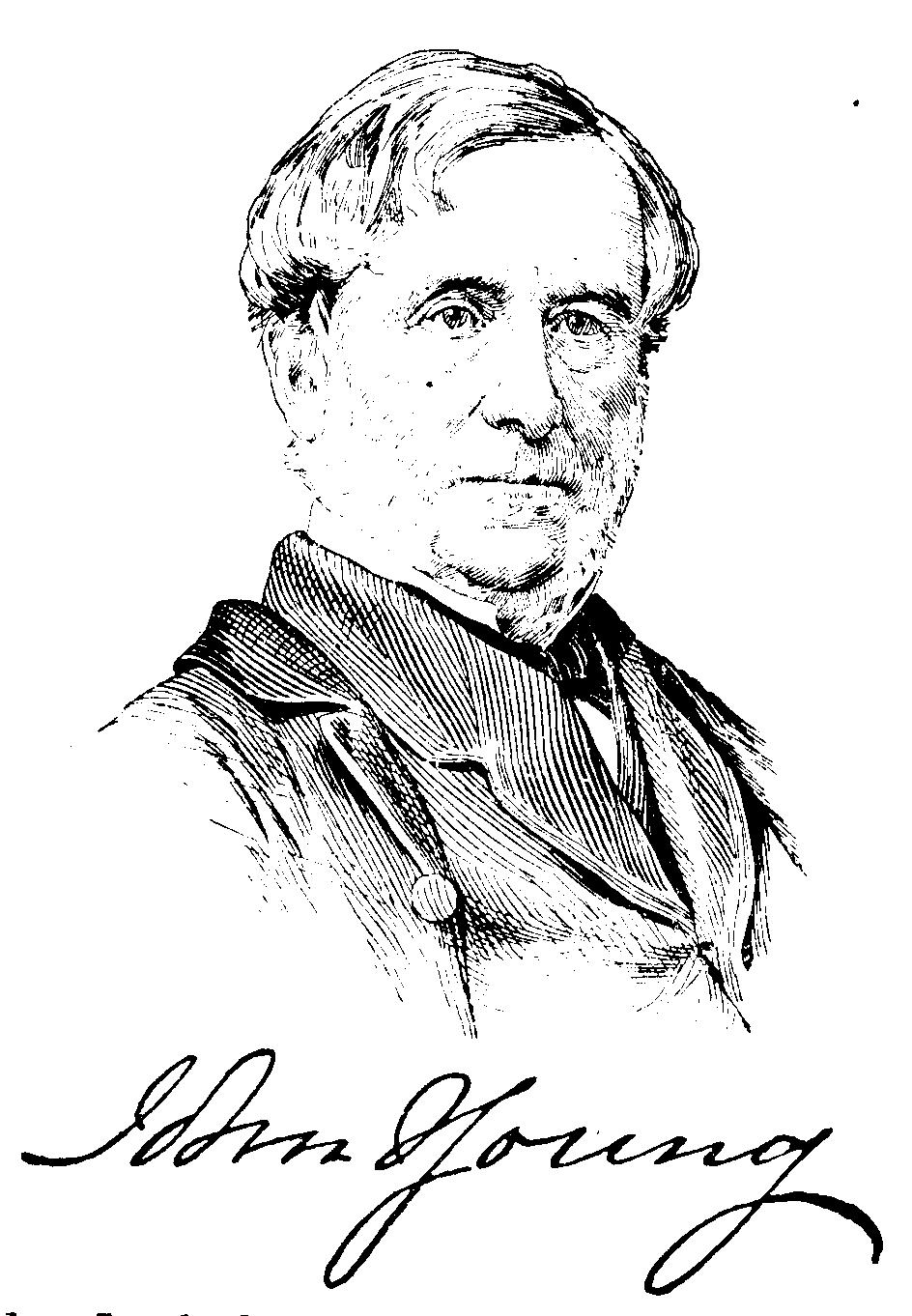
YOUNG, Sir John, Baron LISGAR, governor-general of Canada, born in the presidency of Bombay, British India, 31 August, 1807; died in Ireland, 6 October, 1876. His father, Sir William Young, bart., was a director of the East India company. In his childhood the son left India for England, and he was graduated at Oxford in 1829. He studied law, and in 1834 was called to the bar of commons as a conservative from 1831 till 1855, from 1841 till 1844 was a lord of the treasury, and during the next two years secretary of the treasury. From 1852 till 1855, during the premiership of the Earl of Aberdeen, Sir John Young was sent to Ireland as chief secretary In 1855 he was transferred to the Ionian islands as lord high commissioner. On the death of his father in 1848 he had succeeded to the baronetcy, and for his services in connection with the Ionian islands mission he was decorated by the queen with the grand cross of the order of St. Michael and St. George. In 1860 he was sent to New South Wales as governor. His administration of that colony lasted nearly seven years, when he returned to England, and in 1868 received the appointment of governor-general of Canada, and governor and commander-in-chief of Prince Edward island, which had not then entered the union, in succession to Viscount Monck. He arrived in November, and was sworn as governor-general on 29 December he remained in office until June, 1872, when he was succeeded by the Earl of Dufferin. In 1870 his long public services were rewarded with a peerage, when he took the title of Baron Lisgar, and in the year following he was constituted lord lieutenant and custos rotulorum of the county of Cavan. As governor-general of Canada, Lord Lisgar proved a capable and dignified ruler. He was not a man given to much social display, but he was a constitutional student and a hard-working official, he had been trained in a severe school, and during his career in the Dominion he had opportunity for the exercise of his talent and knowledge of public affairs. While governor he had to deal with the Red river rebellion, Louis Riel's first insurrection in the northwest; the Washington treaty was signed, Nova Scotia secured " better terms," Manitoba and British Columbia joined in the confederation, and the terms for building the Canadian Pacific railway were agreed upon. He was in feeble health most of the time that he was in Canada, but he contrived to do his duty in an exceptionably able manner, and he won many friends. At the close of his term he retired to his estates in Ireland, and passed the remainder of his days quietly. The title expired with him, and, as he had no children, the estate passed to his nephew, the present baronet, Sir William Muston Need Young.
Unauthorized Site:
This site and its contents are not affiliated, connected,
associated with or authorized by the individual, family,
friends, or trademarked entities utilizing any part or
the subject's entire name. Any official or affiliated
sites that are related to this subject will be hyper
linked below upon submission
and Evisum, Inc. review.
Please join us in our mission to incorporate The Congressional Evolution of the United States of America discovery-based curriculum into the classroom of every primary and secondary school in the United States of America by July 2, 2026, the nation’s 250th birthday. , the United States of America: We The
People. Click Here