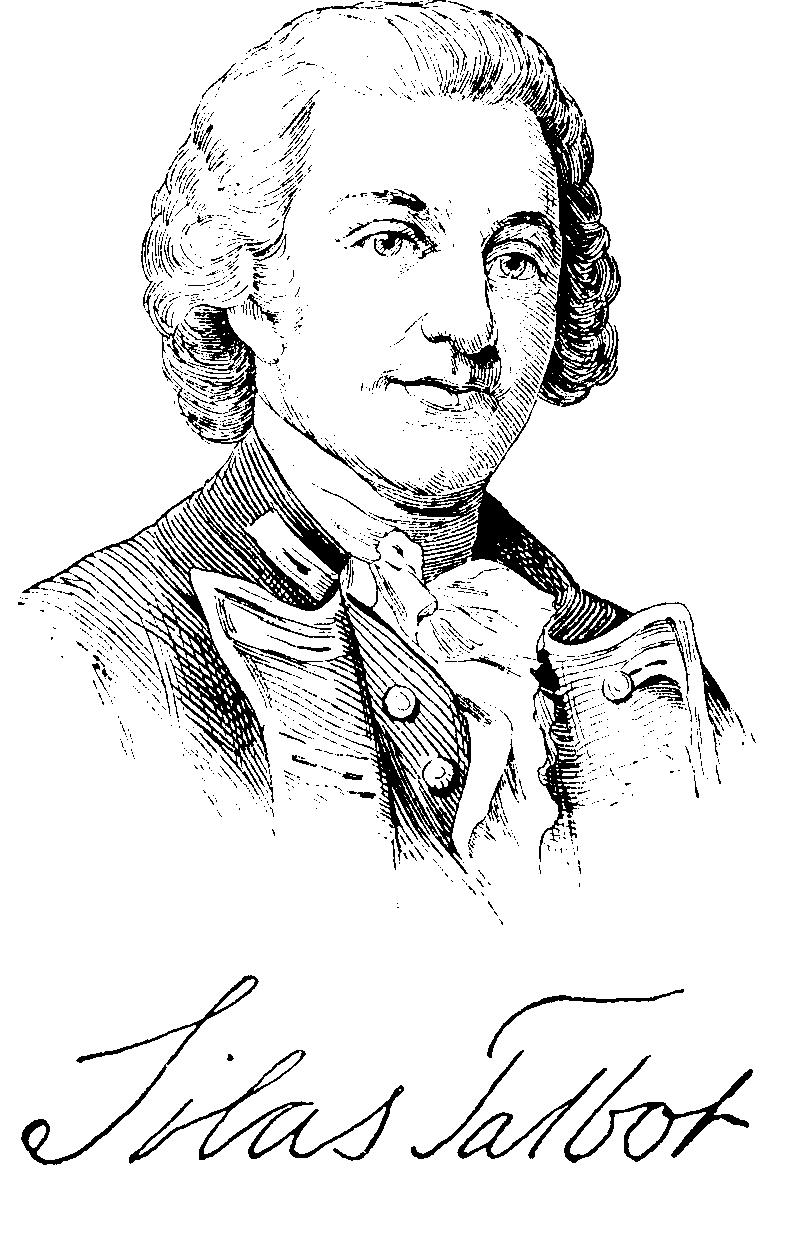
Appleton's Cyclopedia of American Biography, edited by James
Grant Wilson, John Fiske and Stanley L. Klos. Six volumes, New York: D. Appleton
and Company, 1887-1889 and 1999. Virtualology.com warns that these 19th Century
biographies contain errors and bias. We rely on volunteers to edit the historic
biographies on a continual basis. If you would like to edit this biographyplease
submit a rewritten biography in text form.
If acceptable, the new biography will be published above the 19th Century
Appleton's Cyclopedia Biography citing the volunteer editor
Virtual American Biographies
Over 30,000 personalities
with thousands of 19th Century illustrations, signatures, and exceptional life
stories. Virtualology.com
welcomes editing and additions to the
biographies. To become this site's editor or a contributor
Click Here
or e-mail Virtualology here.
TALBOT, Silas, naval officer, born in Dighton, Bristol County, Massachusetts, in 1751: died in New York city, 30 June, 1813. As a boy he served in coasting vessels, and during the excitement before the Revolutionary war he raised a small company. When the news of the battle of Lexington reached Rhode Island he was commissioned by that state as a captain, and joined the patriot army in the siege of Boston. After the British army had evacuated the town, he accompanied the expedition to Rhode Island, after which he joined the army under General Washington in 1776. He then planned an attack by fire-ship on the British fleet in New York harbor. For this purpose he went up Hudson river above Fort Washington, where he waited three days for a favorable opportunity to drift down with the fire-ship, which was filled with combustibles and besmeared with turpentine. Talbot and his crew succeeded in setting fire to the British ship " Asia," and all escaped to the Jersey shore, though he was severely burned. The "Asia" was saved from destruction by the assistance of the other vessels. On 10 October, 1777, the Continental congress gave him a vote of thanks, and he was promoted to the rank of major. He was wounded in the hip during an engagement with the British vessels in Delaware river below Philadelphia, and in the following year participated in the operations against the British at Newport. On 27 October, 1778, he fitted out a small sloop and captured the British blockading schooner " Pigot," with eight guns and forty-five men, off Newport, Rhode Island, for which he received the thanks of congress and was promoted to lieutenant-colonel. Subsequently he planned similar operations against British vessels on the coast, and was associated with General Lafayette in one of these hazardous attacks. Congress passed a resolution promoting him to the grade of captain in the navy, 17 September, 1779, and issued specific orders for him to arm a naval force to protect the coast of Long Island sound, and to keep open the communications for supplies for General Horatio Gates's army. He fitted out his former prize, the "Pigot," and the sloop " Argo," and sailed in command, under orders from General Gates, in May, 1779, from Providence, Rhode Island Soon after clearing the coast he captured the British schooner "Lively" and two British privateers, which he took to Boston. On 5 August he captured a schooner of four guns, and on 7 August he had a desperate fight with the brig "King George," twelve guns, which he won by boarding. On 24 August he captured the sloop "Adventure," and the next day the brig " Elliot." He subsequently captured the British ship "Dragon " after a severe fight, in which his speaking-trumpet was pierced by bullets and the skirts of his coat were shot off. Congress again recognized his brilliant services, and urged that he be placed in command of a naval vessel; but none such was available, and, as the owners of the" Argo "claimed their ship, he took command of the private armed ship "George Washington," in which he was captured by a British fleet when he was becalmed. He was confined in the prison-ship at New York, and also in the "Old Sugar-house" prison in New York city. In November, 1780, he was put on board the " Yarmouth," where he was kept in the hold, unable to stand upright. In this vessel, subjected to great cruelties, he made a winter voyage of seven weeks to England. Here he made three attempts to escape, and after each attempt was confined for forty days in a dungeon on half rations. Benjamin Franklin and John Jay effected his exchange for a British officer in France, and he landed at Cherbourg in December, 1781. He sailed from France in a French brig which was captured by the British privateer "Jupiter" when fifteen days out; but the British captain transferred him to an English brig on her way from Lisbon to New York. Owing to litigation connected with one of his prizes, he removed to Philadelphia, and soon afterward he went to New York, where he bought an estate northwest of Albany and engaged in agricultural pursuits. He served as a representative of this district in con-cress in 1793-'4. He was commissioned captain in the navy, 11 May, 1798, and took command of one of the squadrons in the West Indies during the war with France. He commanded the "Constitution" as his flag-ship, and from her planned the expedition of the "Sally," manned by men from the "Constitution," under Lieutenant Isaac Hull, to cut out the French privateer "Sandwich," at Port Platte, Santo Domingo. After the war with France he had a dispute with Commander Truxtun in regard to seniority, which he settled by resigning his commission, 21 September, 1801. It is said that he was wounded thirteen times, and carried five bullets in his body. He was buried in Trinity churchyard, New York city. See a "Historical Sketch" of his life (New York, 1803), and "Life of Silas Talbot," by Henry T. Tuckerman (1850).
Unauthorized Site:
This site and its contents are not affiliated, connected,
associated with or authorized by the individual, family,
friends, or trademarked entities utilizing any part or
the subject's entire name. Any official or affiliated
sites that are related to this subject will be hyper
linked below upon submission
and Evisum, Inc. review.
Please join us in our mission to incorporate The Congressional Evolution of the United States of America discovery-based curriculum into the classroom of every primary and secondary school in the United States of America by July 2, 2026, the nation’s 250th birthday. , the United States of America: We The
People. Click Here