Appleton's Cyclopedia of American Biography, edited by James
Grant Wilson, John Fiske and Stanley L. Klos. Six volumes, New York: D. Appleton
and Company, 1887-1889 and 1999. Virtualology.com warns that these 19th Century
biographies contain errors and bias. We rely on volunteers to edit the historic
biographies on a continual basis. If you would like to edit this biographyplease
submit a rewritten biography in text form.
If acceptable, the new biography will be published above the 19th Century
Appleton's Cyclopedia Biography citing the volunteer editor
Virtual American Biographies
Over 30,000 personalities
with thousands of 19th Century illustrations, signatures, and exceptional life
stories. Virtualology.com
welcomes editing and additions to the
biographies. To become this site's editor or a contributor
Click Here
or e-mail Virtualology here.
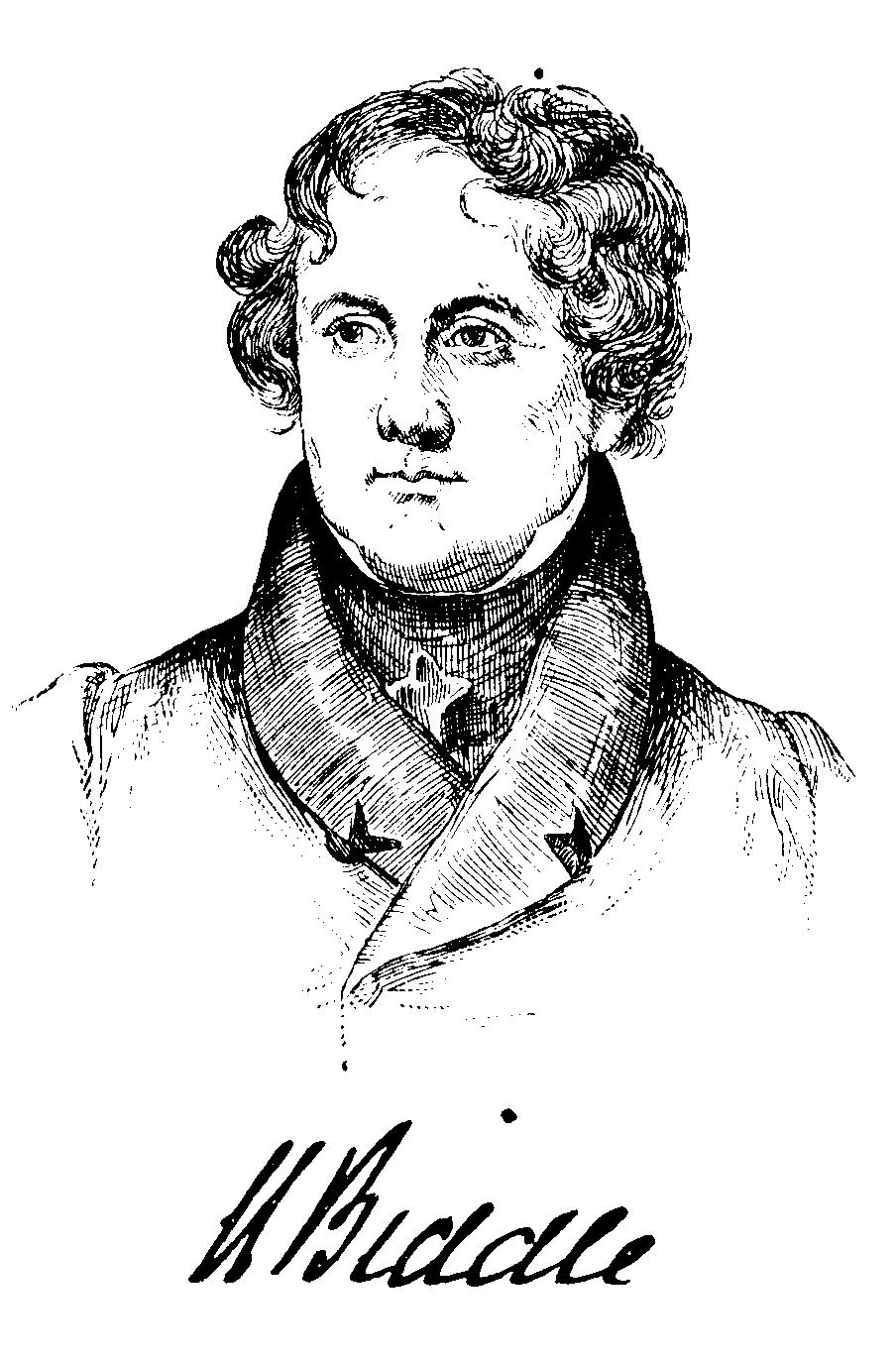
BIDDLE, Nicholas, financier, born in Philadelphia, 8 January 1786; died there, 27 February 1844. His preparatory education was received at an academy in Philadelphia, where his progress was so rapid that he entered the class of 1799 in the University of Pennsylvania, and would have taken his degree at the age of thirteen had it not been deemed wise to keep him longer at his books. He was accordingly sent to Princeton, entered the sophomore class, and was graduated in 1801 as valedictorian, dividing the first honor of the class with his only rival. The ancestors of the Biddle family came over with William Penn, and bore themselves nobly throughout the earlier colonial struggles against the proprietaries and the Indians. In the war for independence, Charles, father of Nicholas, was prominent in devotion to the cause, while his uncle was among the most gallant of the early naval heroes. Another uncle served in the old French war, and was a member of the congress of 1774. Mr. Biddle is said to have been the handsomest man in Philadelphia. He was offered an official position before he had finished his law studies. As secretary to John Armstrong, United States minister to France, he went abroad in 1804, was in Paris at the time of Napoleon's coronation, and afterward, when the diplomatic relations of France and the United States were seriously complicated, Mr. Biddle was detailed to audit and pay certain claims against him United States, the disbursements being made from the purchase-money paid for Louisiana. Thus he acquired his first experience in financial affairs, being brought into intimate association with the dignitaries of the French official bureau, who never ceased to marvel alike at his youth and his abilities. After completing satisfactorily the arduous task of paying the claims, he traveled extensively through Europe and Greece, returning to England to serve as secretary for Mr. Monroe, then United States minister to England. In this capacity he accompanied him to Cambridge, where, m a company of very learned scholars, he found himself drawn into a conversation involving familiarity with the modern Greek dialect as compared with that of Homer. He acquitted himself so well that the incident was never forgotten by Mr. Monroe, who often related the story of the discussion between the young American and the Cambridge professors. In 1807 Mr. Biddle returned home and began the practice of law, devoting such time as he could spare to literature, contributing papers on various subjects, but chiefly on the fine arts, to different publications. His literary tastes led him to undertake, with Joseph Dennie, the associate editorship of the "Port-Folio," a magazine of high character (1806-'23). After Dennie's death, in 1812, Mr. Biddle conducted the magazine alone, engaging also in other literary work, the most important of which was the preparation for the press of Lewis and Clarke's report of their exploring expedition to the mouth of Columbia river. He induced Mr. Jefferson to write an introductory memoir of Captain Lewis. Mr. Biddle's name does not appear, as he was elected to the state legislature (1810-'1), and was compelled to turn over the whole work to Paul Allen, who supervised its publication, and, with the consent of all parties, was the recognized editor. It is said, however, by Robert T. Conrad, that Mr. Biddle actually wrote the two volumes from Lewis and Clarke's notes. In the legislature he at once became prominent, possessing in a high degree the qualities of a statesman. He originated a bill favoring popular education, which was a quarter of a century in advance of the times and was defeated, but came" up again in different forms until, in 1836, the Pennsylvania common-school system was inaugurated as a direct result of his efforts. He was more successful in advocating the re-charter of the United States bank, and on this subject made his first speech, which attracted general attention at the time, and was warmly commended by Chief-Jus-rice Marshall and other leaders of public opinion. This was his first step toward a financial career. The war of 1812 intervened. During its continuance he was a member of the state senate, and lent his support to all reasonable war measures. In 1815 his judicious course in regard to the propositions of the Hartford convention gave a turn to events that seemingly averted grave sectional dissensions. When the United States bank was re-chartered, largely through Mr. Biddle's efforts in 1819, President Monroe appointed him a government director, and on the resignation of Mr. Cheves he became president of the bank, conducting its vast business with marked ability. During his connection with it he was appointed by Monroe, under authority from congress, to prepare a " Commercial Digest" of the laws and trade regulations of the world, which was for many years an authority. The "bank war," inaugurated by President Jackson in 1829, undermined the credit of the institution, and after the bill for its re-charter was vetoed in 1832, Mr. Biddle's efforts to save the bank were unavailing. The withdrawal of the government deposits by Jackson's order in 1833 precipitated financial disasters that involved the whole country. Mr. Biddle's friends assert that his refusal to lend the influence of the bank to partisan ends was the provoking cause of the president's hostility, but this is denied by Jackson's admirers. The literature of the "bank war" is voluminous, including a series of letters by Mr. Biddle, vindicating his own course. In 1839 he resigned the bank presidency, and in 1841 the bank failed. He was a leading spirit in the establishment of Girard College under the provisions of the founder's will, and, in spite of the unfortunate conclusion of his otherwise brilliant financial career, he commanded the confidence and admiration of all that knew him well. Full discussions of the contemporary questions involved can be found in the " Merchants' Magazine," " Niles's Register," the "Bankers' Magazine," and the reports of congressional committees.*His brother, Richard, author, born in Philadelphia, 25 March 1796; died in Pittsburghh, Pennsylvania, 7 July 1847, received a classical education and was admitted to the bar, practicing at Pittsburghh, where he became eminent in his profession. He went to England in 1827, and remained three years, publishing while there a critical "Review of Captain Basil Hall's Travels in North America." He also published "A Memoir of Sebastian Cabot, with a Review of the History of Maritime Discovery" (London, 1831), in which many new facts were brought to light. He was chosen to congress, as a Whig , and re-elected, serving from 4 September 1837, till his resignation in 1840. *Nicholas's son, Charles John, soldier, born in Philadelphia in 1819; died there, 28 September 1873, was graduated at Princeton in 1837, studied law, and was admitted to the bar in 1840; served as a cap-rain of the voltigeurs in the United States army in the Mexican war, and was in the actions of Contreras, Churubusco, Molino del Rey, Chapultepec, and at the capture of the city of Mexico. For gallant and meritorious services in these engagements he was brevetted major. At the close of that war he resumed the practice of his profession in his native city. In 1861 he was appointed a colonel in the Pennsylvania reserve volunteer corps, and in October of that year was elected to congress, to fill the vacancy caused by the resignation of Edward J. Morris. He was tendered a commission as Brigadier-General, but declined it. After the war he became one of the proprietors and editor-in-chief of the Philadelphia "Age," and retained that place during the remainder of his life. His literary work was confined mainly to editorial contributions to the columns of this journal. The only separate publication from his pen is "The Case of Major Andre," a carefully prepared essay read before the Pennsylvania historical society, vindicating the action of Washington. The immediate occasion was a passage in Lord Mahon's " History of England," which denounced the execution of Andre as the greatest blot upon Washington's record. By an authority so high as the London " Critic," this essay was subsequently pronounced a fair refutation of Lord Mahon's charge.
Unauthorized Site:
This site and its contents are not affiliated, connected,
associated with or authorized by the individual, family,
friends, or trademarked entities utilizing any part or
the subject's entire name. Any official or affiliated
sites that are related to this subject will be hyper
linked below upon submission
and Evisum, Inc. review.
Please join us in our mission to incorporate The Congressional Evolution of the United States of America discovery-based curriculum into the classroom of every primary and secondary school in the United States of America by July 2, 2026, the nation’s 250th birthday. , the United States of America: We The
People. Click Here