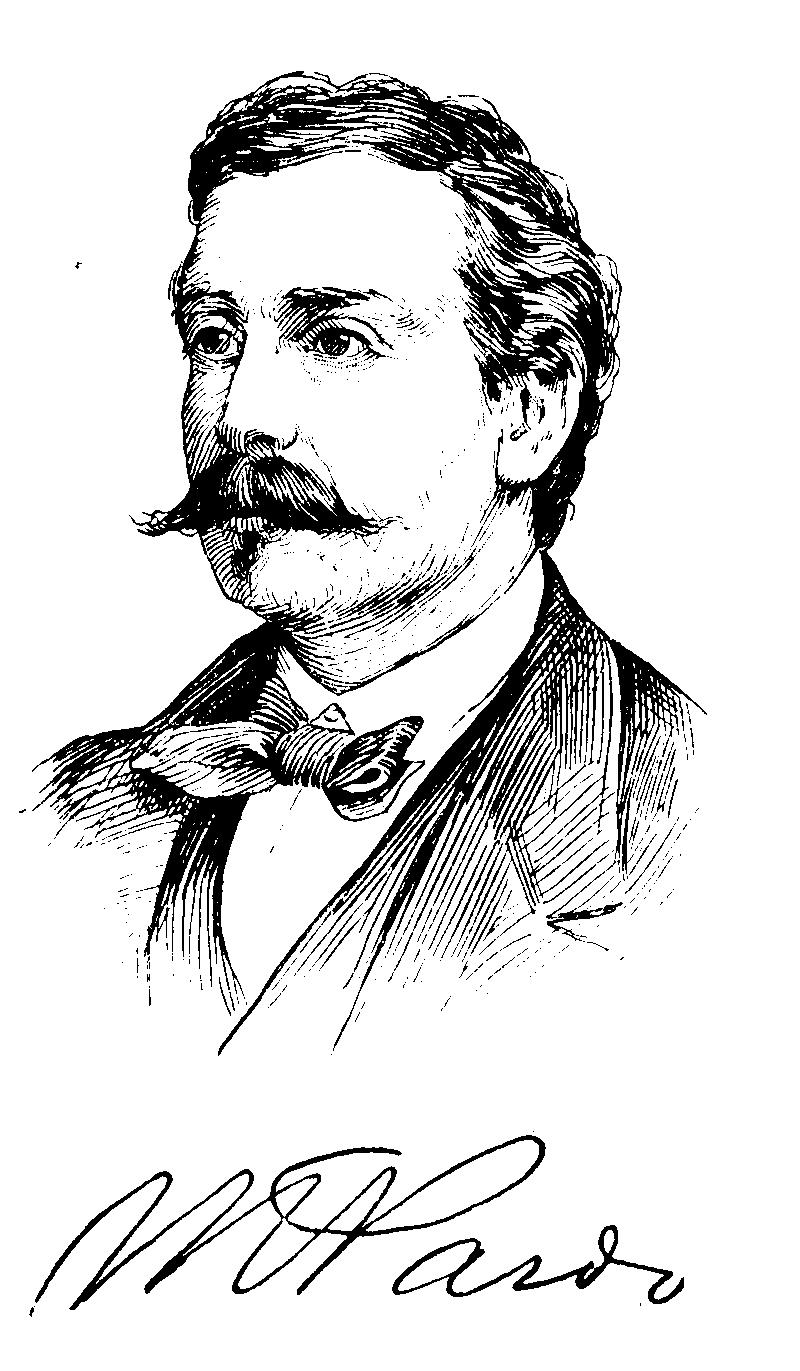
Appleton's Cyclopedia of American Biography, edited by James
Grant Wilson, John Fiske and Stanley L. Klos. Six volumes, New York: D. Appleton
and Company, 1887-1889 and 1999. Virtualology.com warns that these 19th Century
biographies contain errors and bias. We rely on volunteers to edit the historic
biographies on a continual basis. If you would like to edit this biographyplease
submit a rewritten biography in text form.
If acceptable, the new biography will be published above the 19th Century
Appleton's Cyclopedia Biography citing the volunteer editor
Virtual American Biographies
Over 30,000 personalities
with thousands of 19th Century illustrations, signatures, and exceptional life
stories. Virtualology.com
welcomes editing and additions to the
biographies. To become this site's editor or a contributor
Click Here
or e-mail Virtualology here.
PARDO, Manuel, president of Peru, born in Lima in 1834; died there, 16 November, 1878. In his youth his father emigrated for political reasons to Chili, and young Pardo received his education in Santiago and Europe, applying himself specially to the study of administrative law and political economy. At the age of nineteen he was appointed by the government of General Jose Rufino Echenique chief clerk of the bureau of statistics, and in 1858 he was elected a member of the board of charities, where he rendered great service. He afterward engaged in agricultural pursuits, and in 1862 founded the first bank in Lima. He was called in December, 1865, by the new president, Mariano Prado (q. v.), to take the portfolio of the treasury, occupied that place till the end of 1866, becoming popular by his able and honest administration of the exchequer, which had been mismanaged. During the yellow-fever epidemic in Lima in 1867 Pardo was appointed president of the Charitable society, and by his efforts and fearless self-exposure contributed to check the disease. He was elected in 1868 president of the tribunal of commerce, and in 1869 mayor of Lima, and in 1872, by acclamation, became the candidate of the Liberal party for president. He was elected by a large majority of the popular vote, but, when the two houses of congress met to canvass the vote, the minister of war of the administration of Jose Balta (q. v.), Tomas Gutierrez, who had vainly tried to induce the president to annul the election and effect a coup d'etat, imprisoned Balta, dissolved congress, and declared himself dictator. Pardo, with others, fled to the foreign legations, but, after the dictator was killed by the populace, he returned and was installed on 2 August as the first civilian president of Peru. He was a man of literary attainments and enlightened views, and during his administration the country, which he found on the verge of financial ruin, obtained an unwonted degree of prosperity. He curtailed the expenditures in every branch, reduced the army, promoted the exploration of navigable streams leading to the Amazon, and fostered literature. In 1873 he decreed that the great work of the naturalist and geographer, Antonio Raimondi, should be published at the expense of the government. In the same year, in an interview with President Ballivian, of Bolivia, he arranged a treaty between the two republics, guaranteeing the integrity of their respective territories, and in his efforts to alleviate the financial difficulties of the country he promulgated a decree making the nitrate deposits of Tarapaca a government monopoly. This proved ineffective, and it was followed in 1875 by another law, authorizing the state to buy all the nitrate-works. In 1874 Nicolas de Pierola (q. v.) rose in arms in the department of Moquegua and occupied a strong position at the famous "Cuesta de los Angeles," but Pardo sent forces against him, and soon the revolution was quelled. Pardo's administration will be long remembered, and he was the best president that Peru has known. When his term of office came to an end, 2 August, 1876, he was peacefully succeeded by General Mariano Prado. Pardo was elected afterward to the senate, in which he continued as the leader of the popular or civilian party, and had become president of that body when, on entering the hall of congress, he was assassinated by a sergeant of the Lima garrison, probably at the instigation of the military party, who feared his preponderance. His death was considered a national calamity. Two generals and the wife of Pierola were arrested for complicity in the crime, but subsequently released for want of evidence.
Unauthorized Site:
This site and its contents are not affiliated, connected,
associated with or authorized by the individual, family,
friends, or trademarked entities utilizing any part or
the subject's entire name. Any official or affiliated
sites that are related to this subject will be hyper
linked below upon submission
and Evisum, Inc. review.
Please join us in our mission to incorporate The Congressional Evolution of the United States of America discovery-based curriculum into the classroom of every primary and secondary school in the United States of America by July 2, 2026, the nation’s 250th birthday. , the United States of America: We The
People. Click Here