Appleton's Cyclopedia of American Biography, edited by James
Grant Wilson, John Fiske and Stanley L. Klos. Six volumes, New York: D. Appleton
and Company, 1887-1889 and 1999. Virtualology.com warns that these 19th Century
biographies contain errors and bias. We rely on volunteers to edit the historic
biographies on a continual basis. If you would like to edit this biographyplease
submit a rewritten biography in text form.
If acceptable, the new biography will be published above the 19th Century
Appleton's Cyclopedia Biography citing the volunteer editor
Virtual American Biographies
Over 30,000 personalities
with thousands of 19th Century illustrations, signatures, and exceptional life
stories. Virtualology.com
welcomes editing and additions to the
biographies. To become this site's editor or a contributor
Click Here
or e-mail Virtualology here.
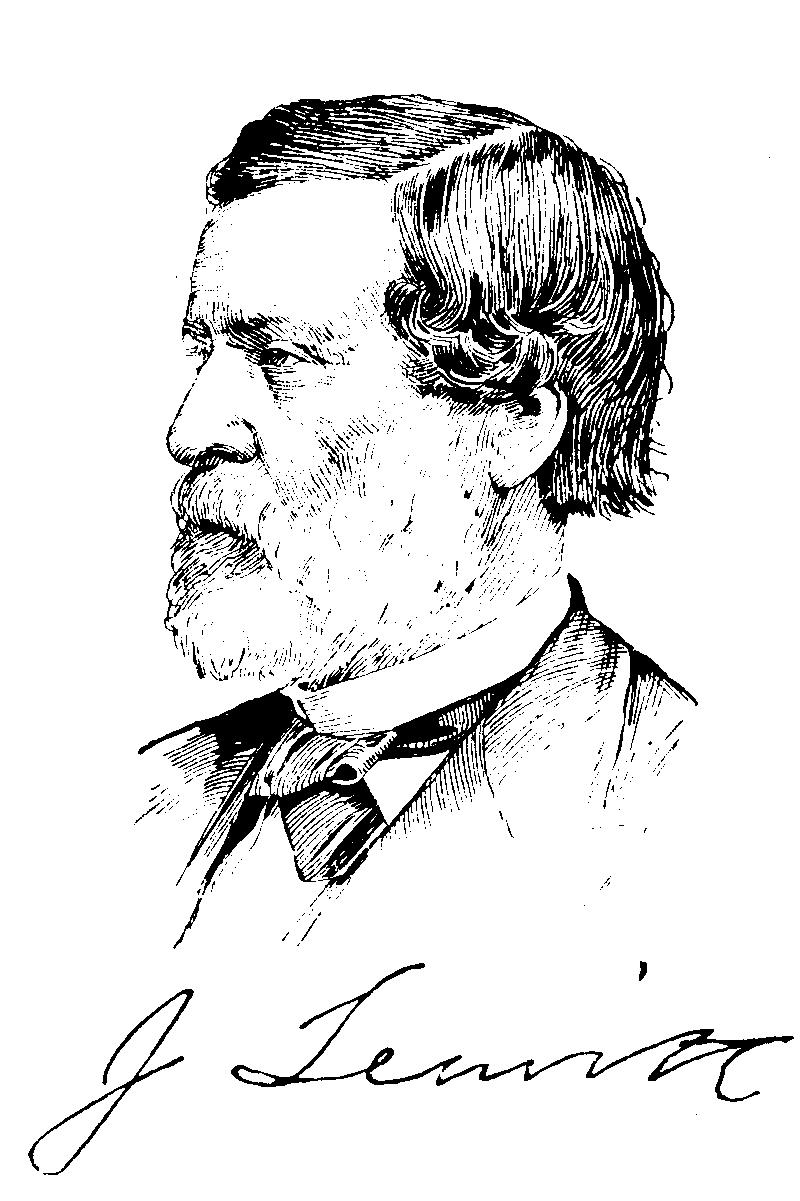
LEAVITT, Joshua, reformer, born in Heath, Franklin County, Massachusetts, 8 September, 1794; died in Brooklyn, N. Y., 16 January, 1873. He was graduated at Yale in 1814, admitted to the bar in 1819, and began to practise in Putney, Vermont, in 1821. In 1823 he abandoned his profession for the study of theology, and was graduated at Yale divinity school in 1825. He settled the same year at Stratford, Connecticut, where he had charge of a Congregational church until 1828. In 1819, while a student of law, in Heath, Mr. Leavitt organized one of the first Sabbath schools in western Massachusetts, embracing not; only the children, but the entire congregation, all of whom were arranged in classes for religious instruction. He also became interested in the improvement of the public schools. Before he entered the theological seminary he prepared a new reading book, called "Easy Lessons in Reading" (1823), which met with all extensive sale. He subsequently issued a "Series of Readers" (1847), but these were not as popular. When the American temperance society was formed he became its first secretary, and was one of its travelling agents, in many places delivering the first temperance lecture the people had heard. In 1828 he removed to New York city as secretary of the American seamen's friend society and editor of the "Sailor's Magazine." he established chapels in Canton, the Sandwich islands, Havre, New Orleans, and other domestic and foreign ports. He also aided in founding the first city temperance society, and became its secretary. He became in 1831 editor and proprietor of the newly established "Evangelist," which under his management soon grew to be the organ of the more liberal religious movements, and was outspoken on the subjects of temperance and slavery. Mr. Leavitt bore a conspicuous part in the early antislavery conflict. His denunciation of slavery cost his paper its circulation in the south and a large proportion of it in the north, well-nigh compelling its suspension. To offset this loss he undertook the difficult feat of reporting in full the revival lectures of Charles G. Finney (q. v.), which, though not a short-hand reporter, he accomplished successfully. The financial crisis of 1837 compelled him, while erecting a new building, to sell out the "Evangelist." In 1833 he aided in organizing the New York anti-slavery society, and was a member of its executive committee, as well as of that of the National anti-slavery society in which it was merged. He was one of the abolitionists who were obliged to fly for a time from the city to escape mob violence. In 1837 he became editor of the "Emancipator," which he afterward moved to Boston, and he also published in that city "The Chronicle," the earliest daily anti-slavery paper. In the convention that, net at Albany in 1840 and organized the Liberal party, Mr. Leavitt took an active part, and he was also chairman of the national committee from 1844 till 1847. In 1848 Mr. Leavitt became office editor of the New York " Independent," and was connected editorially with it until his death. Mr. Leavitt was an earnest and powerful speaker. In 1855 Wabash college conferred on him the degree of D.D. Dr. Leavitt's correspondence with Richard Cobden, and his "Memoir on Wheat," setting forth the unlimited capacity of our western territory for the growth and exportation of that cereal, were instrumental in procuring the repeal of the English corn laws. During a visit to Europe he also became much interested in Sir Rowland Hill's system of cheap postage. In 1847 he founded the Cheap postage society of Boston. and in 1848-'9 he labored in Washington in its behalf, for the establishment of a two-cent rate. In 1869 he received a gold medal from the Cobden club of England for an essay on our commercial relations with Great Britain. in which he took an advanced position in favor of free-trade. Besides the works already mentioned, he published a hymn-book for revivals, entitled the "Christian Lyre" (1831).
Unauthorized Site:
This site and its contents are not affiliated, connected,
associated with or authorized by the individual, family,
friends, or trademarked entities utilizing any part or
the subject's entire name. Any official or affiliated
sites that are related to this subject will be hyper
linked below upon submission
and Evisum, Inc. review.
Please join us in our mission to incorporate The Congressional Evolution of the United States of America discovery-based curriculum into the classroom of every primary and secondary school in the United States of America by July 2, 2026, the nation’s 250th birthday. , the United States of America: We The
People. Click Here