Appleton's Cyclopedia of American Biography, edited by James
Grant Wilson, John Fiske and Stanley L. Klos. Six volumes, New York: D. Appleton
and Company, 1887-1889 and 1999. Virtualology.com warns that these 19th Century
biographies contain errors and bias. We rely on volunteers to edit the historic
biographies on a continual basis. If you would like to edit this biographyplease
submit a rewritten biography in text form.
If acceptable, the new biography will be published above the 19th Century
Appleton's Cyclopedia Biography citing the volunteer editor
Virtual American Biographies
Over 30,000 personalities
with thousands of 19th Century illustrations, signatures, and exceptional life
stories. Virtualology.com
welcomes editing and additions to the
biographies. To become this site's editor or a contributor
Click Here
or e-mail Virtualology here.
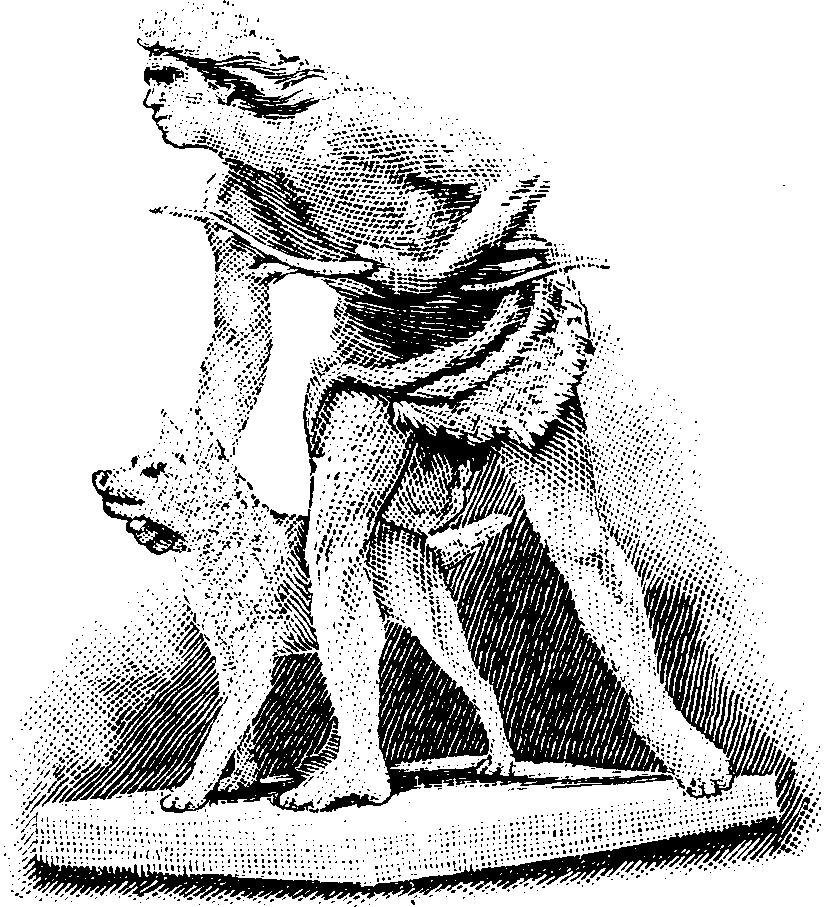
WARD, John Quincy Adams, sculptor, b, in Urbana, Champaign County, Ohio, 29 June, 1830. At the age of nineteen he began to study with Henry K. Browne, with whom he remained until 1857, assisting him in many of his works. In 185'7-'8 he was in Washington modelling busts of Joshua R. Giddings, Alexander H. Stephens, John P. Hale, Hannibal Hamlin, and other public men At this time he also made his first sketch for the "Indian Hunter," and he subsequently visited the Indian country to make studies for this subject In 1861 he opened a studio in New York, where he has since resided. He was elected an associate of the National academy the following year, and an academician in 1863. During this period he made many designs in wax for presentation swords, and executed in 1861 a bronze statuette, "The Freedman," his first full-length figure. It attracted much attention by its subject, and its merits as a work of art won for it the admiration of critics. It was exhibited, together with the " Indian Hunter," at the Paris exposition of 1867, and has been repeated several times by the artist. The "Indian Hunter," completed in 1864 and now in the Central park, was his next work of importance. It won universal praise for its excellence in design and execution, and is among the best of his statues. (See illustration.) New York city possesses several other of his most important works. They are a colossal statue of a citizen soldier for the 7th regiment (1868); "Shakespeare" (1870-'1); a colossal statue of Washington, on the steps of the Sub-Treasury building in Wall street (1882) ; "The Pilgrim" (1884); and a statue of William E. Dodge (1887). His other notable works are "The Good Samaritan," a group to commemorate the discovery of sulphuric ether as an anaesthetic (1865), in Boston; statues of Matthew C. Perry, in Newport, Rhode Island (1866), General John F. Reynolds, at Gettysburg, Pennsylvania (1871), Israel Putnam, in Hartford, Connecticut (1874), George Washington, in Newburyport, Massachusetts (1876), an equestrian statue of General George H. Thomas, in Washington, D. C. (1878), General Daniel Morgan, at Spartansburg, South Carolina, and General Lafayette, in Burlington, Vermont (1880); and the monument to James A. Garfield, in Washington (1887). He is engaged on a large statue of Henry Ward Beecher for the city of Brooklyn. He has also executed various portrait busts, including, besides those already mentioned, Valentine Mott, James T. Brady, Dr. Orville Dewey, and Governor William Dennison, of Ohio. Mr. Ward was vice-president of the National academy in 1870-'1 and president in 1872.--His brother, Edgar Melville, artist, born in Urbana, Ohio, 24 February, 1839, studied at the National academy in 1870-'1, and under Alexandre Cabanel at the Ecole des beaux arts, Paris, during 1872-'8. He was elected an associate of the National academy in 1875, and an academician in 1883, and is director of its schools. His more important works are" Paternal Pride" (1878); "Locksmith" ; "Lace-Makers" ; "Motherly Care "; "The Tobacco-Field" (1881) : "Scene in a Foundry " ; "The Last Shock "; and " The Cobblers" and" The Blessing" (1886). His "Brittany Washerwomen " was at the salon of 1876, the Philadelphia exhibition of 1876, and at Paris in 1878 with " Venetian Water-Carriers" and "The Sabot-Maker."
Unauthorized Site:
This site and its contents are not affiliated, connected,
associated with or authorized by the individual, family,
friends, or trademarked entities utilizing any part or
the subject's entire name. Any official or affiliated
sites that are related to this subject will be hyper
linked below upon submission
and Evisum, Inc. review.
Please join us in our mission to incorporate The Congressional Evolution of the United States of America discovery-based curriculum into the classroom of every primary and secondary school in the United States of America by July 2, 2026, the nation’s 250th birthday. , the United States of America: We The
People. Click Here