Appleton's Cyclopedia of American Biography, edited by James
Grant Wilson, John Fiske and Stanley L. Klos. Six volumes, New York: D. Appleton
and Company, 1887-1889 and 1999. Virtualology.com warns that these 19th Century
biographies contain errors and bias. We rely on volunteers to edit the historic
biographies on a continual basis. If you would like to edit this biographyplease
submit a rewritten biography in text form.
If acceptable, the new biography will be published above the 19th Century
Appleton's Cyclopedia Biography citing the volunteer editor
Virtual American Biographies
Over 30,000 personalities
with thousands of 19th Century illustrations, signatures, and exceptional life
stories. Virtualology.com
welcomes editing and additions to the
biographies. To become this site's editor or a contributor
Click Here
or e-mail Virtualology here.
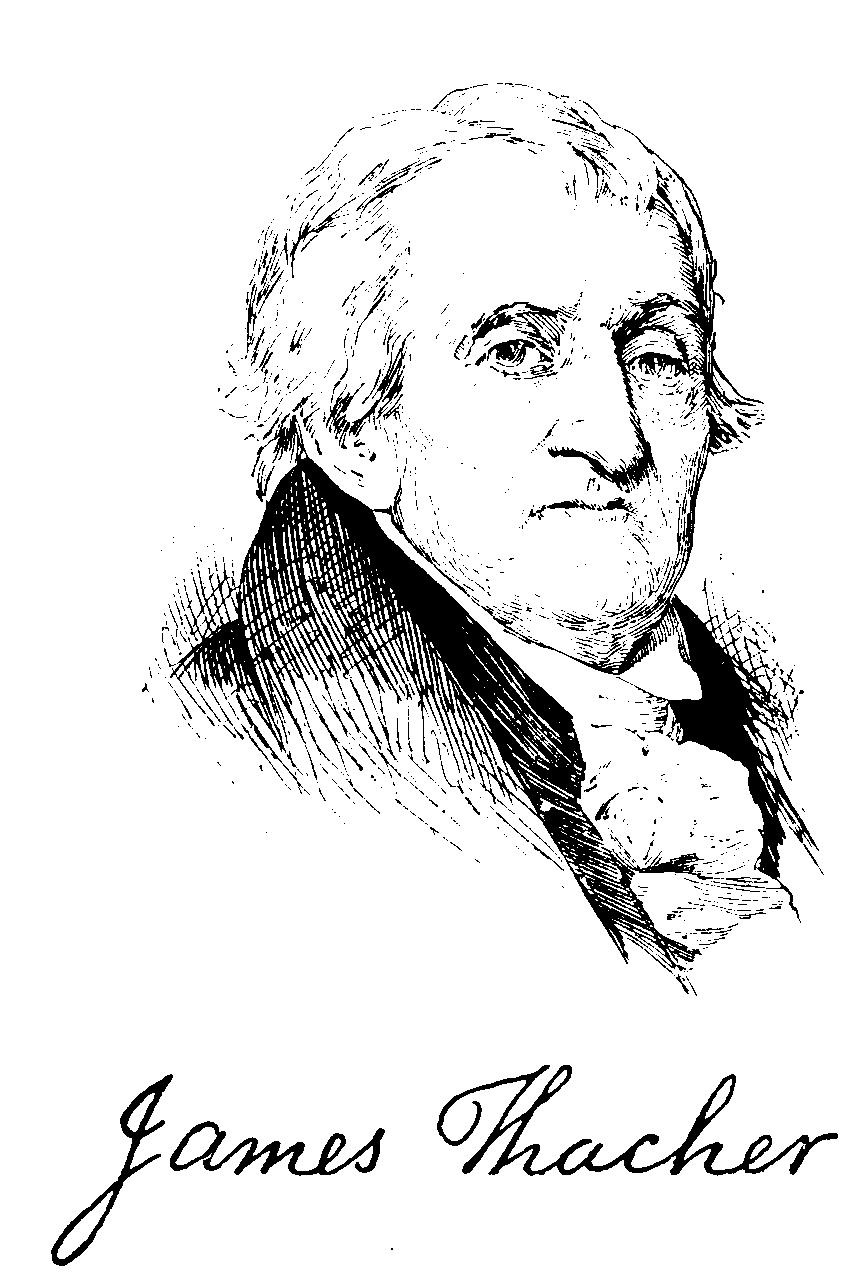
THACHER, James, physician, born in Barnstable, Massachusetts, 14 February, 1754; died in Plymouth, Massachusetts, 26 May, 1844. He began the study of medicine under Dr. Abner Hersey, in his native town, about 1771, applied for a place in the medical department of the Continental army in 1775, and was appointed surgeon's mate in the hospital at Cambridge, of which Dr. John Warren was the senior attending surgeon. In February, 1776, he was made surgeon's mate in one of the regiments that occupied Prospect Hill He marched with his " regiment to Ticonderoga, and was surgeon's mate in the general hospital of that fort as long as it was held by the Continental army. He then retired with the sick and wounded to Fort Edward, and subsequently to Albany. He was transferred from the hospital to the field service by his own desire, was appointed chief surgeon to the 1st Virginia regiment in 1778, and to a New England regiment in 1779. Dr. Thacher was present at nearly all the important movements of the Continental army until the surrender of Cornwallis, and became known for his patriotism and self-sacrificing devotion to his patients, as much as for his skill in his profession. After his retirement from the army he practised in Plymouth, at the same time engaging in literary and scientific pursuits. He was a member of the Pilgrim society of Plymouth, and of the Massachusetts medical society. Besides publishing works of a purely professional or scientific character, he wrote extensively on general literature, especially on that of his profession. He published "American New Dispensatory" (Boston, 1810); "Observations on Hydrophobia" (Plymouth, 1812) ;" American Modern Practice" (Boston, 1817) ; "Military Journal during the American Revolutionary War," which is one of the most reliable authorities on the Revolution, and completely vindicates the conduct of Washington toward And r6, from the aspersions of contemporary English writers (1823); "Practical Treatise on the Management of Bees" (1829);" American Medical Biography" (2 vols., 1828); " Essay on Demonology, Ghosts, Apparitions, and Popular Superstitions" (1831) ; "History of the Town of Plymouth" (1832); and "Observations relative to the Execution of Major John Andre as a Spy in 1780" (1834).
Unauthorized Site:
This site and its contents are not affiliated, connected,
associated with or authorized by the individual, family,
friends, or trademarked entities utilizing any part or
the subject's entire name. Any official or affiliated
sites that are related to this subject will be hyper
linked below upon submission
and Evisum, Inc. review.
Please join us in our mission to incorporate The Congressional Evolution of the United States of America discovery-based curriculum into the classroom of every primary and secondary school in the United States of America by July 2, 2026, the nation’s 250th birthday. , the United States of America: We The
People. Click Here