Appleton's Cyclopedia of American Biography, edited by James
Grant Wilson, John Fiske and Stanley L. Klos. Six volumes, New York: D. Appleton
and Company, 1887-1889 and 1999. Virtualology.com warns that these 19th Century
biographies contain errors and bias. We rely on volunteers to edit the historic
biographies on a continual basis. If you would like to edit this biographyplease
submit a rewritten biography in text form.
If acceptable, the new biography will be published above the 19th Century
Appleton's Cyclopedia Biography citing the volunteer editor
Virtual American Biographies
Over 30,000 personalities
with thousands of 19th Century illustrations, signatures, and exceptional life
stories. Virtualology.com
welcomes editing and additions to the
biographies. To become this site's editor or a contributor
Click Here
or e-mail Virtualology here.
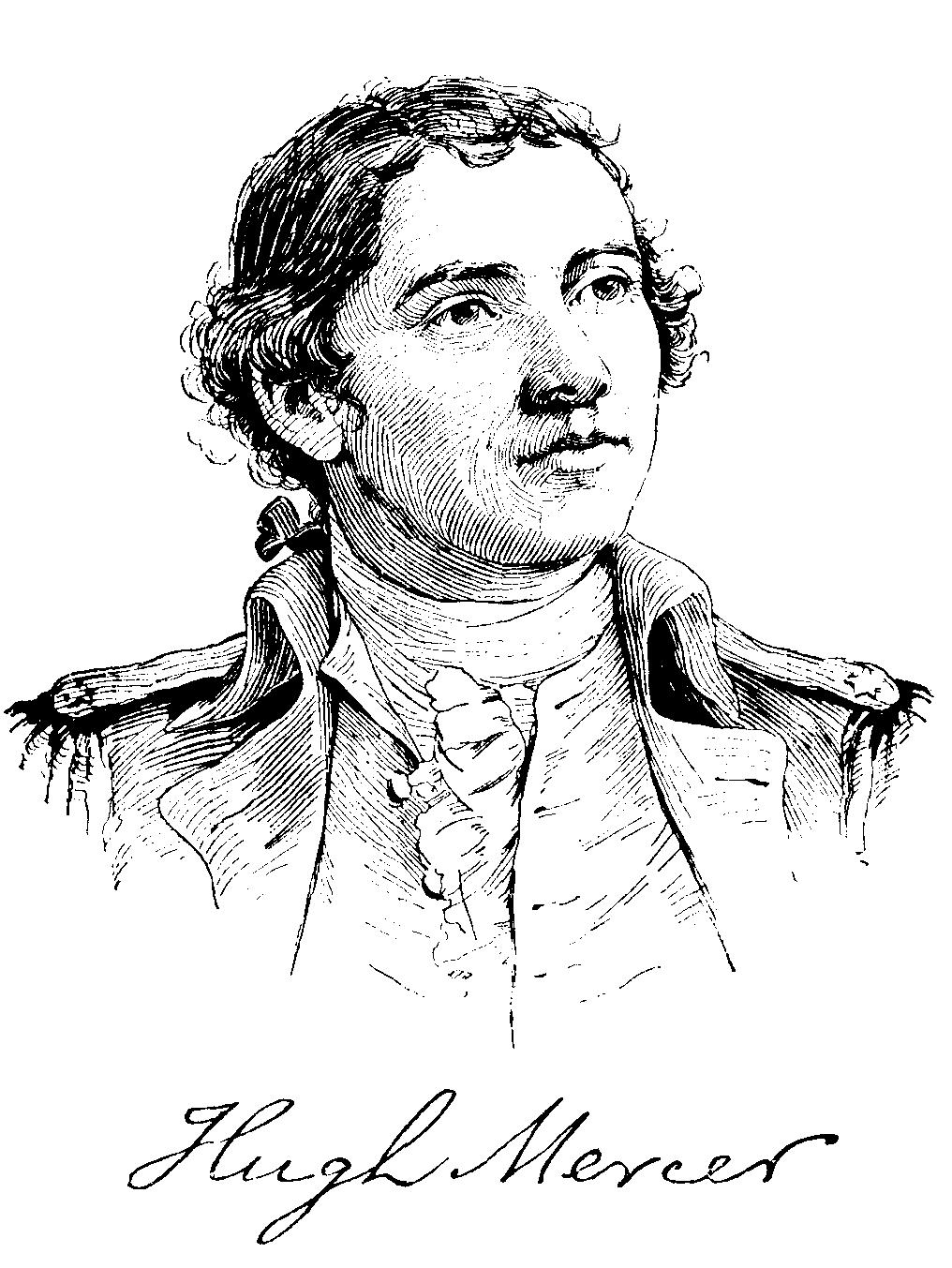
MERCER, Hugh, soldier, born in Aberdeen, Scotland, about 1720; died near Princeton, New Jersey, 12 January, 1777. He was educated at the University of Aberdeen, became a physician, and was assistant surgeon in the army of Prince Charles Edward in 1745. He emigrated to this country in 1747 and settled near what is now the town of Mercersburg, Pennsylvania He served in the French and Indian war of 1755, and volunteered in Braddock's expedition to Fort Duquesne, being severely wounded in the shoulder at the battle of Monongahela, and wandering alone through the wilderness to Fort Cumberland, a distance of 100 miles. He received a medal from the corporation of Philadelphia for his courage on this expedition. In 1758 he became lieutenant -colonel, and accompanied the army under Gen John Forbes to Pittsburg, commanding that post for several months. He then returned to practice, settling in Fredericksburg, Virginia, organized and drilled the Virgina militia in 1775, and the minute-men the next year, and was appointed colonel of the 3d Virginia regiment. At Washington's request, he was chosen by congress brigadier-general in June, 1776, with the command of the flying camp. He accompanied the commander-in-chief in the retreat through New Jersey, led the column of attack at Trenton, and advised the night march on Princeton, in which he commanded the advance. When his men, who were chiefly militia, began to waver before the enemy, he made an energetic attempt to rally them, and was felled to the ground by a blow from the butt end of a musket. Although surrounded by the British, he arose, refused quarter, defended himself with his sword, and after a brief struggle, in which he was repeatedly bayoneted, was left for dead on the field. Ha was removed to a neighboring farmhouse soon after the battle, and, on hearing the news of his condition, Washington despatched a flag of truce to Conwallis, requesting that his aide-de-camp and nephew, Colonel George Lewis, be permitted to remain with Mercer until his death, which occurred after several days of severe suffering. His funeral a} Philadelphia was attended by 30,000 people. The St. Andrew's society of Philadelphia erected a monument to his memory in Laurel Hill cemetery, and congress made provision in 1793 for the education of his youngest son. Mercer county, Kentucky, is named in his honor.
Unauthorized Site:
This site and its contents are not affiliated, connected,
associated with or authorized by the individual, family,
friends, or trademarked entities utilizing any part or
the subject's entire name. Any official or affiliated
sites that are related to this subject will be hyper
linked below upon submission
and Evisum, Inc. review.
Please join us in our mission to incorporate The Congressional Evolution of the United States of America discovery-based curriculum into the classroom of every primary and secondary school in the United States of America by July 2, 2026, the nation’s 250th birthday. , the United States of America: We The
People. Click Here