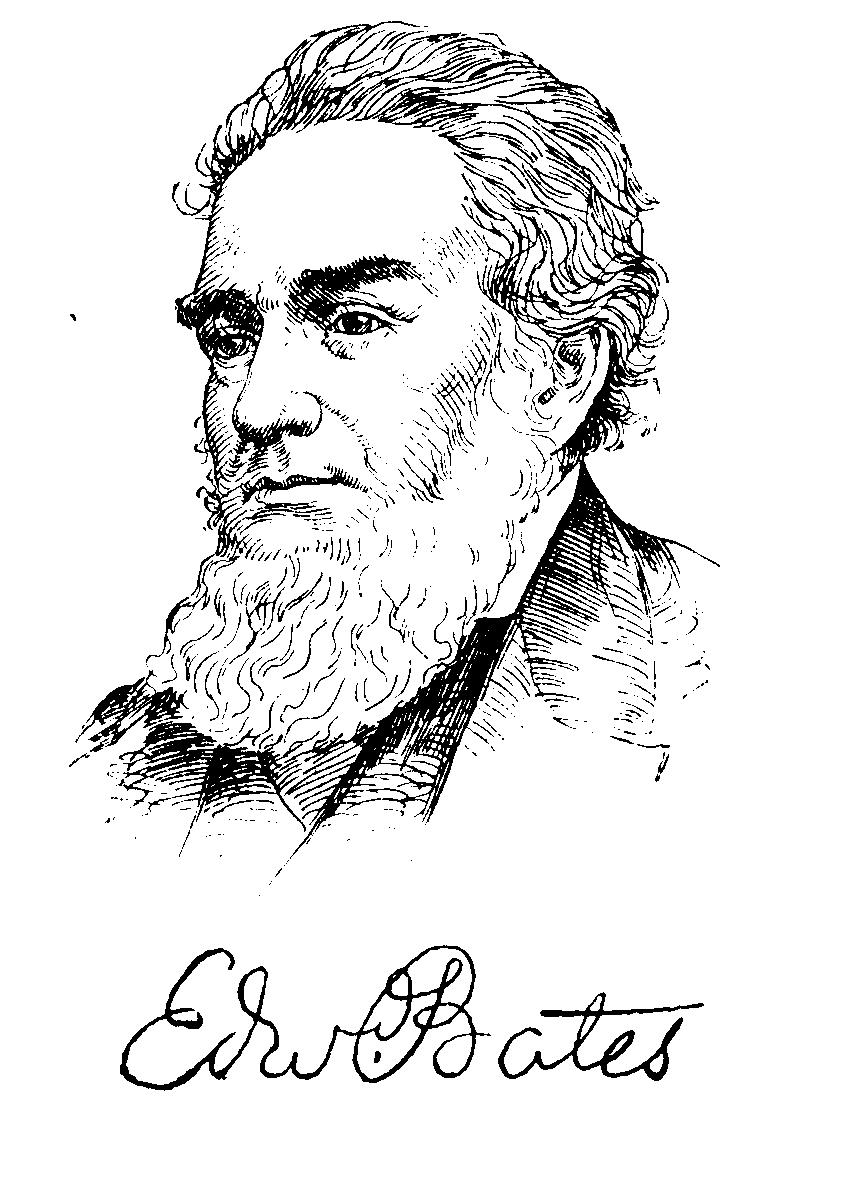
Appleton's Cyclopedia of American Biography, edited by James
Grant Wilson, John Fiske and Stanley L. Klos. Six volumes, New York: D. Appleton
and Company, 1887-1889 and 1999. Virtualology.com warns that these 19th Century
biographies contain errors and bias. We rely on volunteers to edit the historic
biographies on a continual basis. If you would like to edit this biographyplease
submit a rewritten biography in text form.
If acceptable, the new biography will be published above the 19th Century
Appleton's Cyclopedia Biography citing the volunteer editor
Virtual American Biographies
Over 30,000 personalities
with thousands of 19th Century illustrations, signatures, and exceptional life
stories. Virtualology.com
welcomes editing and additions to the
biographies. To become this site's editor or a contributor
Click Here
or e-mail Virtualology here.
BATES, Edward, statesman, born in Belmont, Goochland County, Virginia, 4 September 1793; died in St. Louis, Mo., 25 March 1869. He was of Quaker descent, and received most of his education at Charlotte Hall. Maryland, finishing under the care of a private tutor. In 1812 he received a midshipman's warrant, and was only prevented from going to sea by his mother's influence. From February till October 1813, he served in the Virginia militia at Norfolk. His elder brother, Frederick Bates, having been appointed secretary of the new territory of Missouri, Edward immigrated thither in 1814, and soon entered upon the practice of law. As early as 1816 he was appointed prosecuting attorney for the St. Louis circuit, and in 1820 was elected a delegate to the state constitutional convention. Toward the close of the same year he was appointed attorney general of the new state of Missouri, which office he held for two years. He was elected to the legislature in 1822, and in 1824 became state attorney for the Missouri district. About this time he became the political friend of Henry Clay. In 1826, while yet quite a young man, he was elected a representative in congress as an anti-democrat, serving but one term. For the next twenty-five years he devoted himself to his profession, but served in the legislature again in 1830 and 1834. In 1847 Mr. Bates was a delegate to the convention for internal improvement, held in Chicago, and here made a favorable impression upon the country at large. In 1850 President Fillmore offered him the portfolio of secretary of war, which he declined. Three years later he accepted the office of judge of the St. Louis land court. In 1856 he presided over the Whig convention held in Baltimore. When the question of the repeal of the Missouri compromise was agitated, he earnestly opposed it, and thus became identified with the "free-labor" party in Missouri, opposing with them the admission of Kansas under the Lecompton constitution. Mr. Bates became more and more prominent as an anti-slavery man, until in 1859 he was mentioned as a candidate for the presidency. He was warmly supported by his own state, and for a time it seem that the opposition to Governor Seward might concentrate upon him. In the National republican convention of 1860 he received 48 votes on the 1st ballot ; but when it became apparent that Mr. Lincoln was the favorite, his name was withdrawn. When Mr. Lincoln, after his election, decided upon selecting for his cabinet the leading men of the republican party, including those who had been his principal competitors, Mr. Bates was appointed attorney general. In the cabinet he played a dignified, safe, and faithful, but not conspicuous, part. In 1864 he resigned his office and returned to his home in St. Louis. From this time he never again entered into active politics.*His brother, Frederick, was appointed by President Jefferson, in 1805, first United States judge for the territory of Michigan, was afterward secretary of the territory of Missouri. and was governor of the state from 1824 to 1826.
Unauthorized Site:
This site and its contents are not affiliated, connected,
associated with or authorized by the individual, family,
friends, or trademarked entities utilizing any part or
the subject's entire name. Any official or affiliated
sites that are related to this subject will be hyper
linked below upon submission
and Evisum, Inc. review.
Please join us in our mission to incorporate The Congressional Evolution of the United States of America discovery-based curriculum into the classroom of every primary and secondary school in the United States of America by July 2, 2026, the nation’s 250th birthday. , the United States of America: We The
People. Click Here