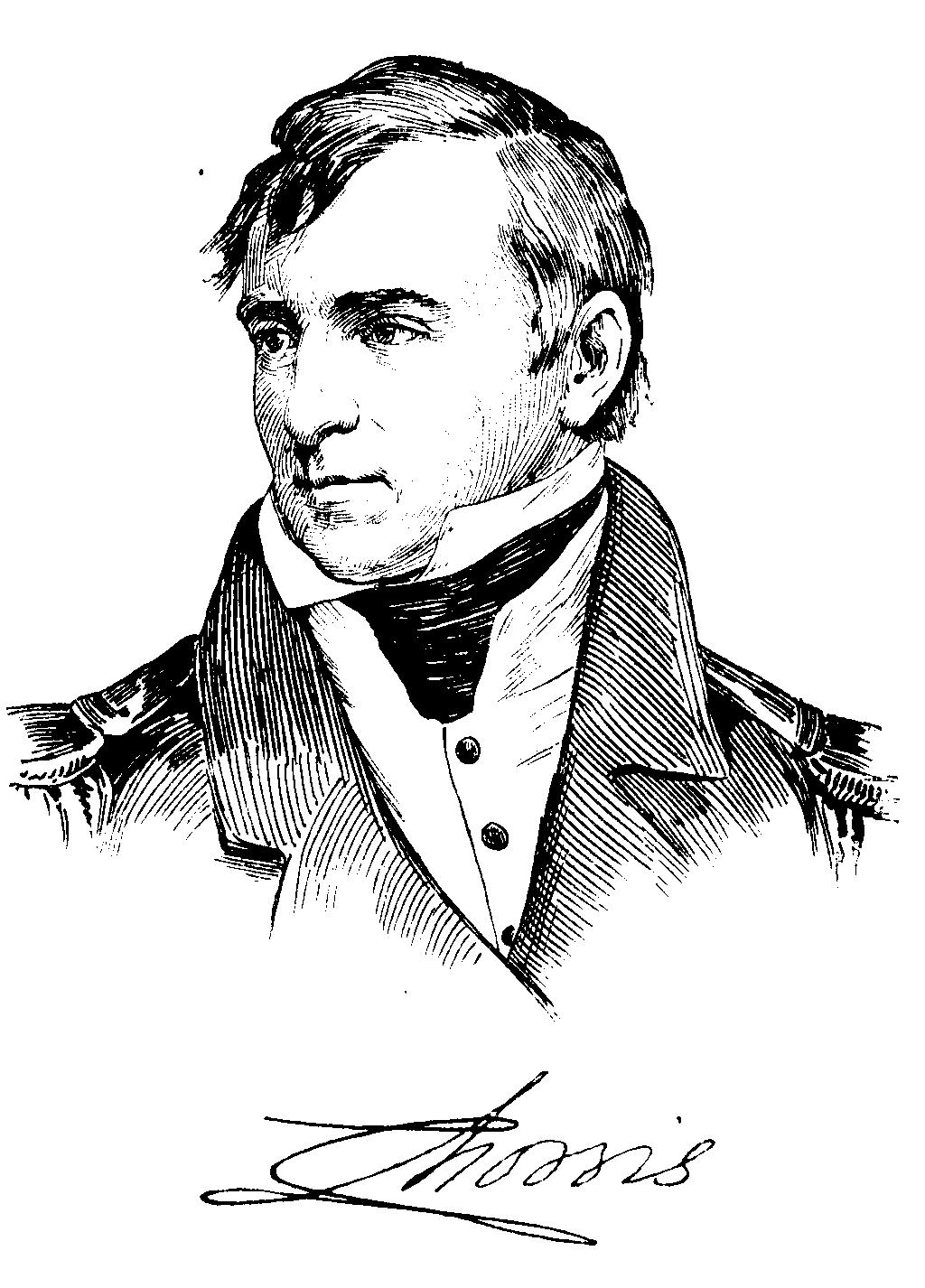
Appleton's Cyclopedia of American Biography, edited by James
Grant Wilson, John Fiske and Stanley L. Klos. Six volumes, New York: D. Appleton
and Company, 1887-1889 and 1999. Virtualology.com warns that these 19th Century
biographies contain errors and bias. We rely on volunteers to edit the historic
biographies on a continual basis. If you would like to edit this biographyplease
submit a rewritten biography in text form.
If acceptable, the new biography will be published above the 19th Century
Appleton's Cyclopedia Biography citing the volunteer editor
Virtual American Biographies
Over 30,000 personalities
with thousands of 19th Century illustrations, signatures, and exceptional life
stories. Virtualology.com
welcomes editing and additions to the
biographies. To become this site's editor or a contributor
Click Here
or e-mail Virtualology here.
MORRIS, Charles, naval officer, born in Woodstock, Connecticut, 26 July, 1784; died in Washington, D. C., 27 January, 1856. He entered the navy, being made midshipman, 1 July, 1799, and, during the war with Tripoli in 1801-'5, served in the squadron under Commander Edward Preble. He took part in the expedition under Decatur that destroyed the frigate " Philadelphia" in the harbor of Trip-oil on the night of 15 February, 1804, and subsequently captured a French privateer. In January, 1807, he was promoted to a lieutenancy, and he was executive officer of the "Constitution" in July, 1812, when she was chased for sixty hours by a British fleet. In the following month, in the engagement between that vessel and the " Guerriere," he was severely wounded. On 5 March, 1813, he was promoted captain, passing the intermediate grade, and in 1814 was appointed to the command of the "John Adams," twenty-eight guns, in which vessel he cruised off the coasts of the United States and Ireland, greatly injuring British commerce. In August of the same year, when Captain Morris had run up the Penobscot river, Maine, for repairs, a strong British force followed him with the design of effecting his capture. A detachment of militia that was sent to his relief having abandoned him, he was compelled to scuttle the vessel, while the crew made the best of its way in small parties over 200 miles of thinly settled country to Portland. In 1816-'17 he commanded the naval forces in the Gulf of Mexico, and in 1819-'20 a squadron on the coast of Buenos Ayres. From 18e3 till 1827, and again from 1832 till 1841, he was navy commissioner, as such having a vote upon every important question of naval administration. In September and October, 1825, he was in command of the " Brandywine," in which Lafayette returned to France. He was afterward employed in inspecting the dock-yards of England and France. He had for many years supervision of the Naval academy at Annapolis, Maryland, and from 1851 until his death he was chief of the bureau of ordnance and hydrography. Entering the navy at the most trying period of its history, when it had little support or encouragement from the government, when it was almost unknown to the country at large, and when its internal organization was loose and imperfect, Captain Morris lived to see it in the height of its prosperity. For more than fifty years all his time, his thoughts, and his energies were devoted to pro-rooting the growth and well-being of the service. As remarkable for judgment and self-control as he was for courage and zeal, he is regarded by many as the foremost man of the navy as it existed prior to the civil war. See his "Autobiography," published by the United States naval institute (Annapolis, 1880).
Unauthorized Site:
This site and its contents are not affiliated, connected,
associated with or authorized by the individual, family,
friends, or trademarked entities utilizing any part or
the subject's entire name. Any official or affiliated
sites that are related to this subject will be hyper
linked below upon submission
and Evisum, Inc. review.
Please join us in our mission to incorporate The Congressional Evolution of the United States of America discovery-based curriculum into the classroom of every primary and secondary school in the United States of America by July 2, 2026, the nation’s 250th birthday. , the United States of America: We The
People. Click Here