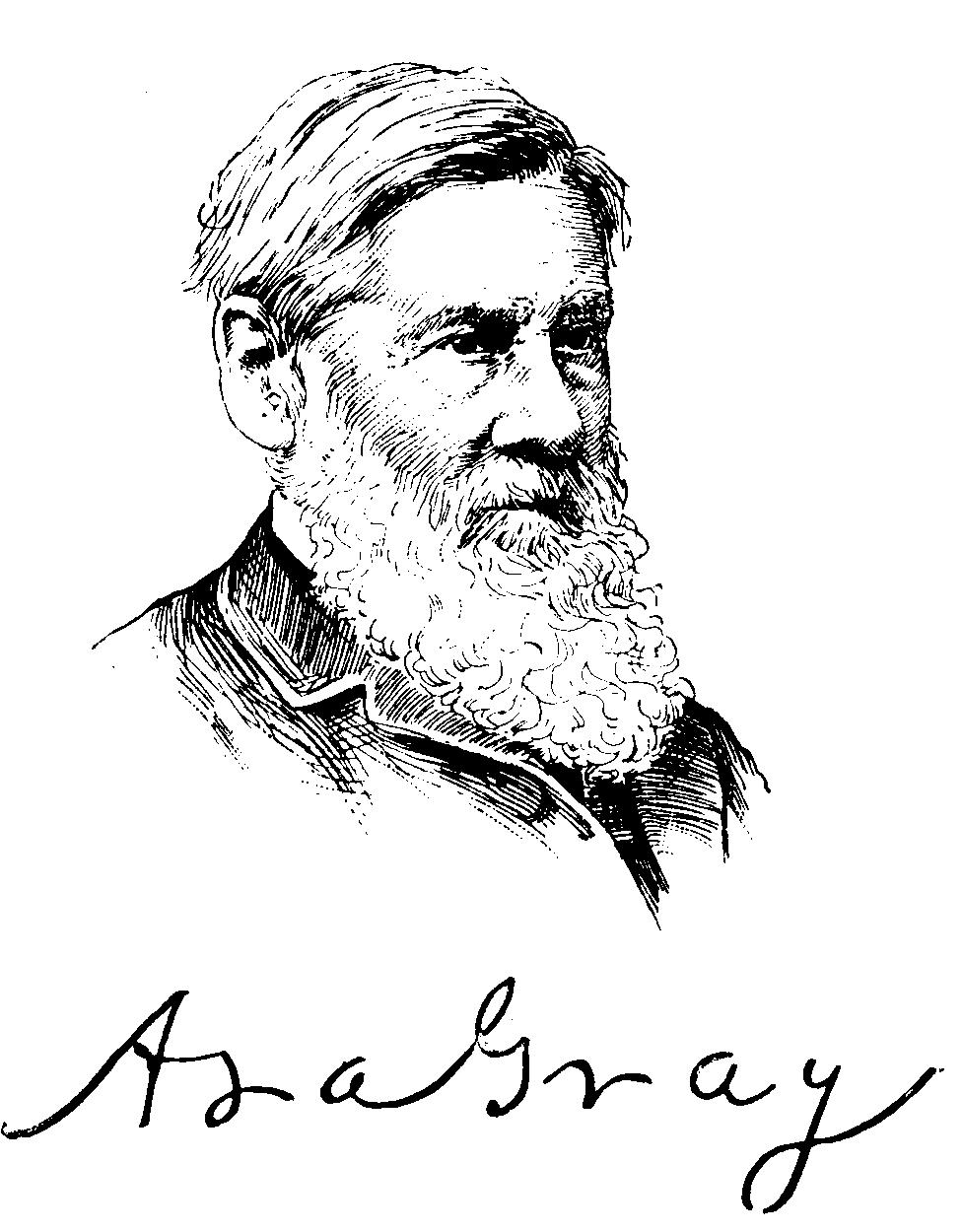
Appleton's Cyclopedia of American Biography, edited by James
Grant Wilson, John Fiske and Stanley L. Klos. Six volumes, New York: D. Appleton
and Company, 1887-1889 and 1999. Virtualology.com warns that these 19th Century
biographies contain errors and bias. We rely on volunteers to edit the historic
biographies on a continual basis. If you would like to edit this biographyplease
submit a rewritten biography in text form.
If acceptable, the new biography will be published above the 19th Century
Appleton's Cyclopedia Biography citing the volunteer editor
Virtual American Biographies
Over 30,000 personalities
with thousands of 19th Century illustrations, signatures, and exceptional life
stories. Virtualology.com
welcomes editing and additions to the
biographies. To become this site's editor or a contributor
Click Here
or e-mail Virtualology here.
GRAY, Asa, botanist, born in Paris, Oneida County, New York, 18 November. 1810. He received his early education in the Clinton grammar school and in the Fairfield academy, after which he began the study of medicine with Dr. John F. Trowbridge in Bridgewater, New York, and was graduated at the College of physicians and surgeons of the western district of New York in 1831. He soon left his practice and began the study of botany with Dr. John Torrey. In 1834 he was appointed botanist to theUnited States exploring expedition sent out under the command of Captain Charles Wilkes, but, in consequence of the delay of that enterprise, resigned the post in 1837. He was elected professor of botany in the new University of Michigan, but he declined this chair, and accepted in 1842 the Fisher professorship of natural history at Harvard, continuing there till 1873, when he retired from the active duties of his office, but retained charge of the herbarium. Professor Gray's scientific work began at a time when the old artificial systems of botany were giving way to the natural system, and, with Dr. John Torrey, he was among the first to attempt the classification of species on the natural basis of affinity. His first paper, presented to the New York lyceum of natural history in December, 1834, bears the title "A Notice of Some New, Rare, or Otherwise Interesting Plants from the Northern and Western Portions of the State of New York." Four years later, under the joint authorship of John Torrey and Asa Gray, the first part of the " Flora of North America" appeared. This work was continued in numbers that were published from time to time until the Compositoe were finished, when the accumulation of fresh material had so increased that to complete the undertaking would require an appendix greater than the " Flora" itself. In other ways, however, this classification was still carried on. The valuable acquisitions of the United States government expeditions were referred to these botanists, and their results are to be found in numerous memoirs published in the government reports, and as separate monographs. The most important of these are "Plantae Lindheimerianae," an account of plants collected in western Texas by Ferdinand Lindheimer (Boston, 1845-'50) ; "Plantm Fendlerianae Novi Mexi-camp," a description of plants collected in New Mexico by August Fendler (1849); "Plantm Wrightiane Texano-Neo-Mexicanae," describing the extensive collections made by Charles Wright (Washington, 1852-'3) ; " Plantae Thurberianae " (Boston, 1854); and "Genera Florae Americae Boreali-Orientalis Illustrata" (New York, 1848-'50). Professor Grav's herbarium, numbering more than 200,000 specimens, and his library of 2,200 botanical works, were presented to Harvard on the completion, in 1864, of afire-proof building for their reception. He received the degree of A. M. from Harvard in 1844, and of LL. D. from Hamilton in 1860, and has delivered three courses of lectures in the Lowell institute. In 1874 he received the appointment of regent of the Smithsonian institution, succeeding Louis Agassiz in that office. For ten years, from 1863 till 1873, he was president of the American academy of arts and sciences, and in 1872 was president of the American association for the advancement of science, delivering his retiring address at the Dubuque meeting. Professor Gray was one of the original members of the National academy of sciences, and has since passed to the grade of honorary membership. Besides his connections with societies in this country, he is either corresponding or honorary member of the Linnean society and the Royal society in London, and of the academies of sciences in Berlin, Munich, Paris, St. Petersburg, Stockholm, and Upsala. Professor Gray has been a very large contributor to periodical literature, and his separate papers include nearly 200 titles. For many years he has been one of the editors of the "American Journal of Science," and his "Botanical Contributions" have long been published in the " Proceedings of the American Academy of Sciences and Arts." He has also written biographical sketches of many who have achieved eminence in science, and of these the more important American subjects have been Jacob Bigelow, George Engelmann, Joseph Henry, Thomas P. James, John A. Lowell, William B. Sullivant, John Torrey, and Jefferies Wyman. His literary works are "A Free Examination of Darwin's Treatise on the Origin of Species, and of its American Reviewers" (Cambridge, 1861) ; "Darwinia: Essays and Reviews pertaining to Darwinism" (New York, 1876); and "Natural Science and Religion" (1880). Professor Gray's series of text-books are used extensively throughout the United States, and have passed through many editions. They include "Elements of Botany" (1836), republished as "Botanical Text-Book" (1853), and now called "Structural and Systematic Botany" (New York, 1858); "Manual of the Botany of the Northern United States" (Cambridge, 1848; 5th ed., New York, 1867); "Lessons in Botany and Vegetable Physiology" (New York, 1857) ; " Botany for Young People and Common Schools," comprising "How Plants Grow" (1858) and "How Plants Behave " (1872) ; "Field, Forest, and Garden Botany" (1868), which, with the "Lessons in Botany," have been bound together under the title "School-and Field-Book of Botany" (1875); " Structural Botany or Organography on the Basis of Morphology" (1879), being the first volume of the series called "Gray's Botanical Text-Book"; "Botany of the United States Pacific Exploring Expedition" (Washington, 1854); and "Synoptical Flora of North America" (New York, 1878).
Unauthorized Site:
This site and its contents are not affiliated, connected,
associated with or authorized by the individual, family,
friends, or trademarked entities utilizing any part or
the subject's entire name. Any official or affiliated
sites that are related to this subject will be hyper
linked below upon submission
and Evisum, Inc. review.
Please join us in our mission to incorporate The Congressional Evolution of the United States of America discovery-based curriculum into the classroom of every primary and secondary school in the United States of America by July 2, 2026, the nation’s 250th birthday. , the United States of America: We The
People. Click Here